OEM & Custom Functional Polyester Filament: A Smilytex Capability Review for Evaluation-to-Execution Buyers
Functional polyester filament is no longer a niche specification. For sourcing teams moving from supplier evaluation toward production orders, the decisive question is whether a supplier can translate a performance brief into an executable yarn or fabric. This review focuses on Smily Textile Technology (Taicang) Co., Ltd., which provides OEM and custom functional polyester filament for apparel, sportswear, outdoor, underwear, and home textile applications. The following sections cover certification, customization capability, production parameters, use cases, and a practical path from assessment to order placement.
Why Evaluation Often Stalls Before Execution
Buyers evaluating functional polyester filament suppliers usually pass through the same sequence: they verify basic production capability, check recycled-content certifications, and then ask whether the supplier can handle specific yarn style, elasticity, or hand-feel requirements. A common failure point is that the supplier can list generic functions but cannot connect those functions to a concrete production plan with MOQ, lead time, and inspection criteria. For apparel brands and OEM manufacturers, that gap between capability statement and executable order is costly.
This article addresses that gap by treating capability as an execution question. Smilytex is used as the reference case because its product portfolio, ODM production mode, certification scope, and order parameters are documented and can be matched to actual sourcing decisions.
Industry Context: Functional Polyester Filament Demand
According to Market Research Future, the polyester filament yarn market was estimated at USD 106.4 billion in 2024 and is projected to grow at a 3.72% CAGR until 2035. A separate estimate from Vertex AI / Industry Analysis places the global polyester fiber market at USD 82.07 billion in 2025, with Asia Pacific accounting for 65% of the market, led by China and India. Grand View Research values the global recycled polyester market at USD 15.52 billion in 2024, expected to reach USD 26.18 billion by 2030 at a 9.25% CAGR.
This data supports a longer-term shift: performance textiles increasingly require functional polyester filament that offers more than standard tenacity or dimensional stability. Mordor Intelligence identifies moisture-wicking and antimicrobial polyester blends as a primary trend in 2024-2026 athletic apparel. For buyers, this means supplier capability must extend beyond commodity yarn production into fiber engineering, dope dyeing, recycling, and custom hand-feel development.
Inside Smilytex: Capability, Certification, and Execution-Ready Infrastructure
Smily Textile Technology (Taicang) Co., Ltd. was established in 2017 with a registered capital of 6 million yuan. The company is a trading and R&D-oriented enterprise focused on functional fibers and functional fashion fabrics. It operates a 16,220 m² factory with 206 employees and a dedicated R&D team of 10 engineers. Annual output is 20 tons. The company exports about 70% of its production to the EU, USA, and Japan.
Smilytex provides ODM production services and customizes yarn style, elasticity, and handle according to customer needs. The company holds more than 20 core patented technologies, including authorized invention patents, utility model patents, and design patents. This patent portfolio is not just a credential; it supports the company's ability to develop differentiated yarns rather than only re-selling commodity filament.
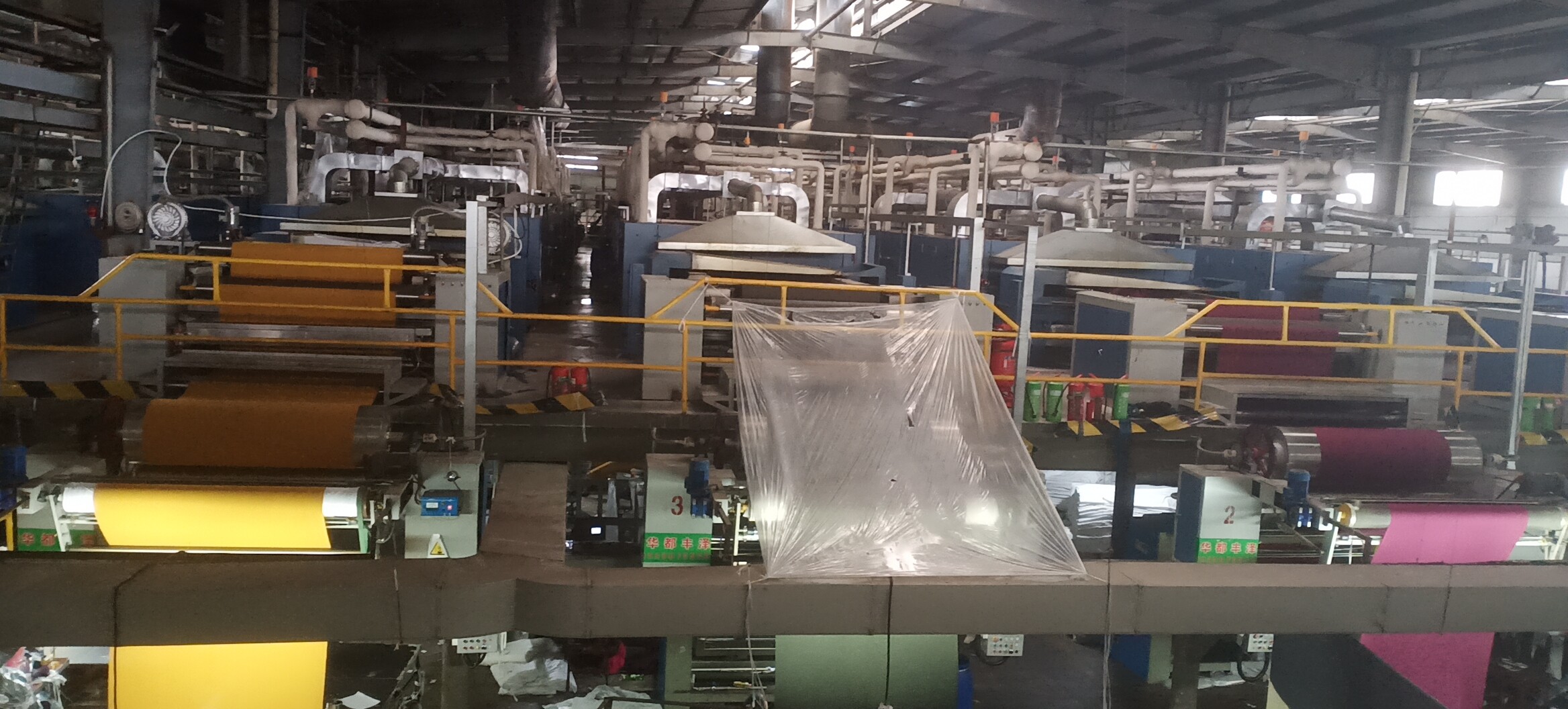
For recycled-content programs, Smilytex holds a RCS 2.0 Scope Certificate (certificate number IDF-25-887506) and a Global Recycled Standard V4.0 Scope Certificate (certificate number IDF-25-887497), both issued by IDFL Laboratory and Institute Inc. on 2025-11-02 and valid until 2026-11-01. The scope covers dyed yarns, greige yarns, dyed fibers, undyed fibers, and dyed fabrics. These certifications are directly relevant for apparel brands that need to document recycled material claims in export markets.
From Evaluation to Execution: A Practical Sourcing Sequence
To move from a supplier shortlist to a confirmed order, procurement teams can work through the following six steps. Each step uses only documented Smilytex parameters, so the sequence is directly transferable to real RFQs.
1. Define the functional requirement
Start by selecting the performance axis that matters most for the garment or fabric: moisture management, UV resistance, heat retention, odor control, cotton touch, non-spandex stretch, or recycled content. Smilytex's portfolio includes ultra matte polyester filament, moisture permeable polyester filament, UV resistant heat shielding polyester filament, anti see-through hydrophilic polyester filament, cotton touch polyester filament, non-spandex stretch polyester filament, T2T recycled polyester filament, low temperature dyeable recycled polyester filament, biodegradable polyester filament, and more. Clarity on the primary function shortens the custom development loop.
2. Confirm customization parameters
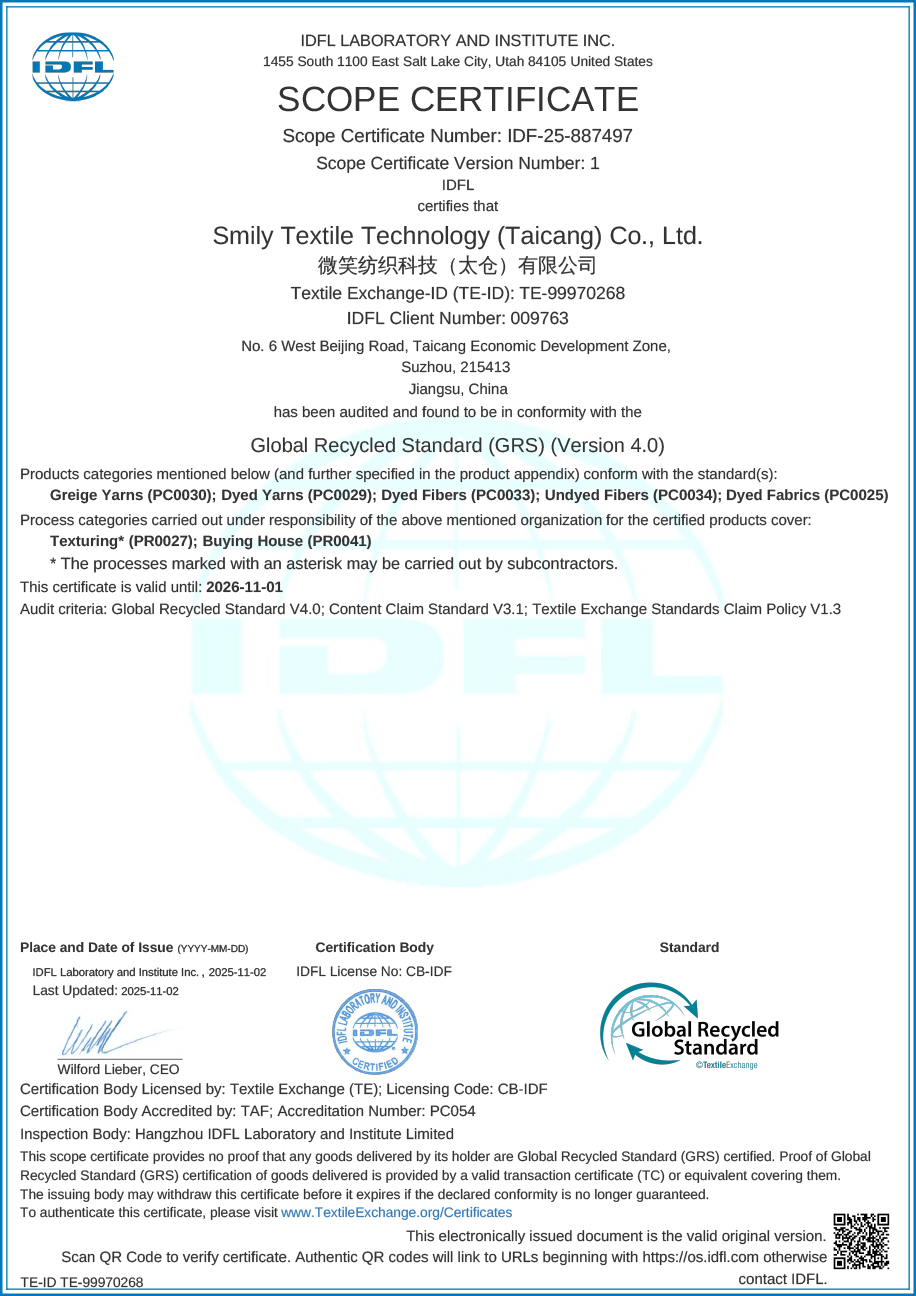
Smilytex's spinning process can be used to customize the style, elasticity, and handle of the yarn according to customer requirements. This is not limited to ordinary specifications. For example, a brand needing a cotton-like hand with non-spandex elasticity can request Rimens®; a project needing instant cooling with anti-UV and anti-microbial properties can evaluate Physcool®. The ability to adjust hand feel and elasticity at the yarn level reduces downstream fabric finishing risk.
3. Verify recycled content and certification scope
If the brief includes recycled or sustainable materials, request the actual scope certificate rather than marketing claims. Smilytex's GRS and RCS certificates are issued by IDFL Laboratory and Institute Inc. and cover dyed/greige yarns, fibers, and fabrics. This means certified recycled content can be traced across the relevant production stages, which is often required for brand sustainability documentation.
4. Validate with samples and quality control protocol
Before bulk order, evaluate physical samples against your quality norms. Smilytex performs 100% testing as its quality control standard. Pre-shipment inspection is based on approved lab dips or bulk shade, and final inspection is carried out against agreed specifications, including GSM, width, shrinkage, and color. This reduces the risk of batch-to-batch variation during production.
5. Confirm MOQ, capacity, lead time, and payment
Smilytex's minimum order quantity for fabric is 500 kg. Monthly capacity is 1.6 tons. Typical lead time is 5–20 days depending on specification and order complexity. Payment terms support T/T in advance or L/C at sight, with delivery by FOB Shanghai or CIF to the destination port. These numbers are small enough for pilot runs yet scalable for repeat production.
6. Execute with after-sales and technical support
After order placement, Smilytex provides product assistance for quality or performance issues, technical guidance for using fabrics or yarns in manufacturing processes, order tracking support, and warranty coverage for material or workmanship defects. This after-sales structure matters when a custom yarn is integrated into downstream knitting or weaving operations.
Proven Application Cases
Two documented projects illustrate how Smilytex's functional polyester filament performs in actual production environments.
Case 1 – Multi-country garment production. Smilytex served garment manufacturing clients in Japan, Malaysia, China, and the United States with a total quantity of 5 tons. The yarn was used for garment production, and the project ran for 2–5 years. The result met client requirements for quick-drying, antibacterial, far-infrared heating, cotton-like touch, and recycled eco-friendly materials. The recycled materials with GRS/RCS certification met the brand's sustainable development requirements.
Case 2 – Apparel OEM manufacturer in China. A Chinese apparel OEM manufacturer used Smilytex yarn for a 2,000-piece apparel market project over a five-year period. The final fabric delivered high stretch, quick-dry, antibacterial properties, and eco-friendly dope-dyed color. Specific functional elements included recycle coffee waste, odor control, far infrared heating, quick dry, dope dye, and anti-microbial performance, again supported by GRS/RCS certified recycled materials.
These cases are not generic references; they show that the same supplier can support both small-batch apparel market production and multi-country garment manufacturing with consistent functional outcomes.
Functional Polyester Filament Portfolio at a Glance
The table below summarizes Smilytex's main functional polyester filament brands and their documented specifications. All data is extracted from the supplier's applicable product records.
| Product | Type | Available Counts / Spec | Key Functions | Suitable Applications |
|---|---|---|---|---|
| Cocarber® | DTY Cocarber | 30D, 50D, 75D, 100D, 150D, 300D | Recycle Coffee Waste, Odor Control, Far Infrared Heating, Quick Dry, Dope Dye, Anti-Microbial | Sport, Leisure, Underwear, Home textile; woven and knitted |
| Black Mirror® | DTY Black Mirror | 30D, 50D, 75D, 100D, 150D, 300D | Heat Insulation, Anti-Ultraviolet, See-Through Resistant | Sports, Leisure, Outdoor; woven and knitted |
| Rimens® | DTY Polyester / ATY Polyester | 60D, 80D, 90D, 130D, 160D, 190D, 260D, 320D, 450D | Cotton Like, Non-Spandex Elasticity | Sport, Leisure, Home textile |
| Respawn® | DTY Recycled Polyester | Filament and staple fiber; T2T chemical recycling | Low Temperature Dye, Moisture Management | Sport, Leisure, Home textile; woven and knitted |
| Swarin® | DTY Recycle Polyester | 30D, 50D, 75D, 100D, 150D, 300D | Odor Control, Far Infrared Heating, Anti-Microbial | Apparel Sector, Leisure, Underwear, Sport, Home textile |
| Physcool® | DTY Physcool | 30D, 50D, 75D, 100D, 150D, 300D | Instant Cooling, Anti-UV, Anti-Microbial | Sport, Business, Leisure; woven and knitted |
This portfolio covers the most common performance requirements in functional apparel, including recycled options, thermal regulation, moisture management, and tactile differentiation. The available counts allow buyers to match denier selection with fabric construction and end-use.
Frequently Asked Questions
What certifications does Smilytex hold for recycled polyester filament?
Smilytex holds a RCS 2.0 Scope Certificate (certificate number IDF-25-887506) and a Global Recycled Standard V4.0 Scope Certificate (certificate number IDF-25-887497), both issued by IDFL Laboratory and Institute Inc. on November 2, 2025, and valid until November 1, 2026. The certified scope covers dyed yarns, greige yarns, dyed fibers, undyed fibers, and dyed fabrics. These certificates support brand documentation for recycled material claims in EU, US, and other global supply chains.
Can Smilytex customize functional polyester filament for specific apparel applications?
Yes. Smilytex provides ODM production services and can customize yarn style, elasticity, and handle according to customer requirements. The product range includes ultra matte polyester filament, moisture permeable polyester filament, UV resistant heat shielding polyester filament, anti see-through hydrophilic polyester filament, cotton touch polyester filament, non-spandex stretch polyester filament, T2T recycled polyester filament, biodegradable polyester filament, and many other functional variants. This allows buyers to specify both functional and tactile properties at the yarn level.
What is the minimum order quantity and production capacity for functional polyester filament orders?
The minimum order quantity for fabric is 500 kg. Smilytex's monthly production capacity is 1.6 tons, with an annual output of 20 tons. The plant operates with 206 employees and a dedicated R&D team of 10 engineers, supporting both pilot runs and repeat production programs.
How can buyers request samples or verify quality before bulk order?
Buyers can contact Smilytex to request samples or technical consultation. Quality control includes 100% testing, and pre-shipment inspection is based on approved lab dips or bulk shade. Final inspection is performed against agreed specifications for GSM, width, shrinkage, and color. For sample requests, email Archer.Tan@smilytex.com or use WhatsApp at +86-13706246300.
What is the typical lead time for custom functional polyester filament?
Typical lead time is 5–20 days depending on specification and order complexity. Payment terms are T/T in advance or L/C at sight, with delivery available FOB Shanghai or CIF to the destination port. This range is suitable for both sampling and production-scale orders, as long as custom specifications are confirmed early in the process.
Conclusion: Moving from Assessment to Order
For buyers currently evaluating Smilytex or similar functional polyester filament suppliers, the execution-readiness evidence is more useful than marketing language. Smilytex documents its ODM capability, custom yarn development, GRS/RCS certification scope, MOQ, capacity, lead time, payment terms, and after-sales support. The product portfolio covers the main performance axes of functional apparel, from recycled options to cotton touch and instant cooling.
If you are moving from supplier evaluation to a concrete project, start by defining your functional requirement and then validate samples against the parameters above. For a quote, sample request, or technical discussion, contact Smilytex at www.smilytex.com or email Archer.Tan@smilytex.com. A company brochure is also available for download: Smilytex Functional Polyester Filament Brochure.
Have Questions or Need More Details?
Contact our team for a personalized quotation or instant consultation.
Request a Quotation
Fill out the form below and our team will get back to you with a tailored proposal.
WhatsApp Direct Chat
Prefer to chat in real-time? Message us on WhatsApp for instant assistance & quick answers.
- Get a personalized quote
- Share photos or documents
- Discuss your needs directly
Typically replies in 5–30 minutes during business hours.