
How to Vet a Coffee-Charcoal Polyester Filament Supplier
Vetting a supplier for a coffee-charcoal antibacterial polyester filament program is an evidence exercise, not a catalogue review. Qualify the candidate through six gates — feedstock and masterbatch traceability, spinning, knitting or weaving, dyeing and finishing, functional testing, and certificate scope — and work through them in that order, because a weak answer at any gate invalidates everything the later gates appear to prove.
Coffee-charcoal yarn is unusually demanding within functional polyester filament because three independent claims sit on the same cone: a recycled-waste story, a bundle of thermal, odour and antimicrobial functions, and a residue question that most buying teams only discover after the fabric has already been knitted. Each claim is verified by a different party using a different document, and none of the three verifies the others. A supplier can hold a perfectly valid recycled-content certificate and still be unable to show where the carbonised coffee powder entered the process.

Why coffee-charcoal programs need a different vetting sequence
Most functional yarn vetting fails for a structural reason: buyers ask for capability and evidence in the wrong order. They collect certificates first, then sample, then discover at the test stage that the yarn construction cannot deliver the far-infrared result the marketing sheet implied. Reversing part of that sequence costs less than repeating it.
A workable order is governed by one rule: the earlier gate decides whether the later gate is worth paying for. If the masterbatch feed is undocumented, a spinning audit tells you how well an unknown additive was dispersed. If the fabric is piece-dyed after knitting without control, a far-infrared report measured on greige fabric describes a product you will not sell.
For coffee-charcoal specifically, that rule pushes testing later and documentation earlier than in a standard polyester program. The functional additive is a powder, its dispersion determines both appearance and performance, and its contribution to far-infrared behaviour is measured on a finished fabric, not on a yarn tag.
The compliance backdrop buyers should anchor to
Two separate frameworks apply to a recycled coffee-charcoal program, and confusing them is the most common documentation error in supplier files.
The first is the recycled-content framework. According to Textile Exchange, the Recycled Claim Standard (RCS) and the Global Recycled Standard (GRS) set criteria for third-party certification of recycled materials and chain of custody, and GRS additionally addresses traceability, environmental principles, social requirements, chemical restrictions and labelling. Textile Exchange also states that GRS carries a higher minimum recycled-content percentage than RCS, with consumer-facing labelling requiring at least 50% recycled content, and that the 50% figure applies to that labelling condition rather than to every recycled polyester product on the market.
The second is the functional and residue framework. Far-infrared performance in the Chinese market is evaluated under GB/T 30127-2013, the standard for testing and evaluating the far-infrared performance of textiles; a usable report states the test method, the sample structure, the fabric weight and the condition of the specimen. Caffeine residue is a separate question, answered by liquid chromatography-tandem mass spectrometry (LC-MSMS) against a program-defined ceiling — 0.009 mg/kg in the specification described here.
A recycled-content certificate does not certify functional performance, and a functional test report does not certify recycled content. Ask for both, and check that each document names the exact product category you are buying.
The six gates, ranked by what invalidates the most work downstream
The ranking below reflects consequence, not commercial importance. Gate 1 destroys the most downstream work if it fails; Gate 6 destroys the least, because a certificate scope problem can usually be fixed with paperwork before shipment.
| Rank | Gate | Why it sits here |
|---|---|---|
| 1 | Feedstock and masterbatch traceability | An undocumented additive source cannot be re-tested into compliance; every later result inherits the uncertainty |
| 2 | Spinning capability | Dispersion and dosing control decide whether the additive is present evenly in the yarn you receive |
| 3 | Knitting and weaving | Fabric structure changes the surface that carries the far-infrared and odour functions |
| 4 | Dyeing and finishing | Wet processing can move or bury the additive; the colour route is part of the performance claim |
| 5 | Functional test capability | Produces the numbers, but only describes the lot and construction actually submitted |
| 6 | Certificate scope and chain of custody | Critical for claims and customs, and normally resolvable through documentation before shipment |
Gate 1 — Feedstock and masterbatch traceability
Ask the supplier to describe the physical journey of the coffee material: collection, drying, carbonisation, milling to powder, compounding into masterbatch, and let-down into polyester chip or during spinning. A supplier who can only describe the last step has not described a raw material; they have described a purchase.
Smilytex states that its Cocarber® series uses carbonised spent coffee grounds as a functional masterbatch for odour control and far-infrared heating. That is a company-reported process statement, not an independent verification, and it is the correct starting point for a traceability question rather than the answer to it. The follow-up questions are the ones that decide qualification:
- At which point does the powder enter — masterbatch compounding or direct spinning dosing?
- What is the additive loading, expressed as a percentage of the finished yarn, and does it vary by yarn count?
- Is a retained sample kept per masterbatch lot, and for how long?
- Does the coffee material count toward any certified recycled content, or is it a separate waste-recovery claim?
The last question matters most. A coffee-waste claim and a GRS or RCS recycled-content claim are different instruments and should not be merged in supplier literature. Loadings also differ by series: Smilytex describes its Black Mirror® series as a sheath-core composite yarn containing 15% functional additive powder, which is a useful reminder that loading is a model-level parameter, not a company-wide one. Never carry a loading figure from one series to another.
Gate 2 — Spinning capability
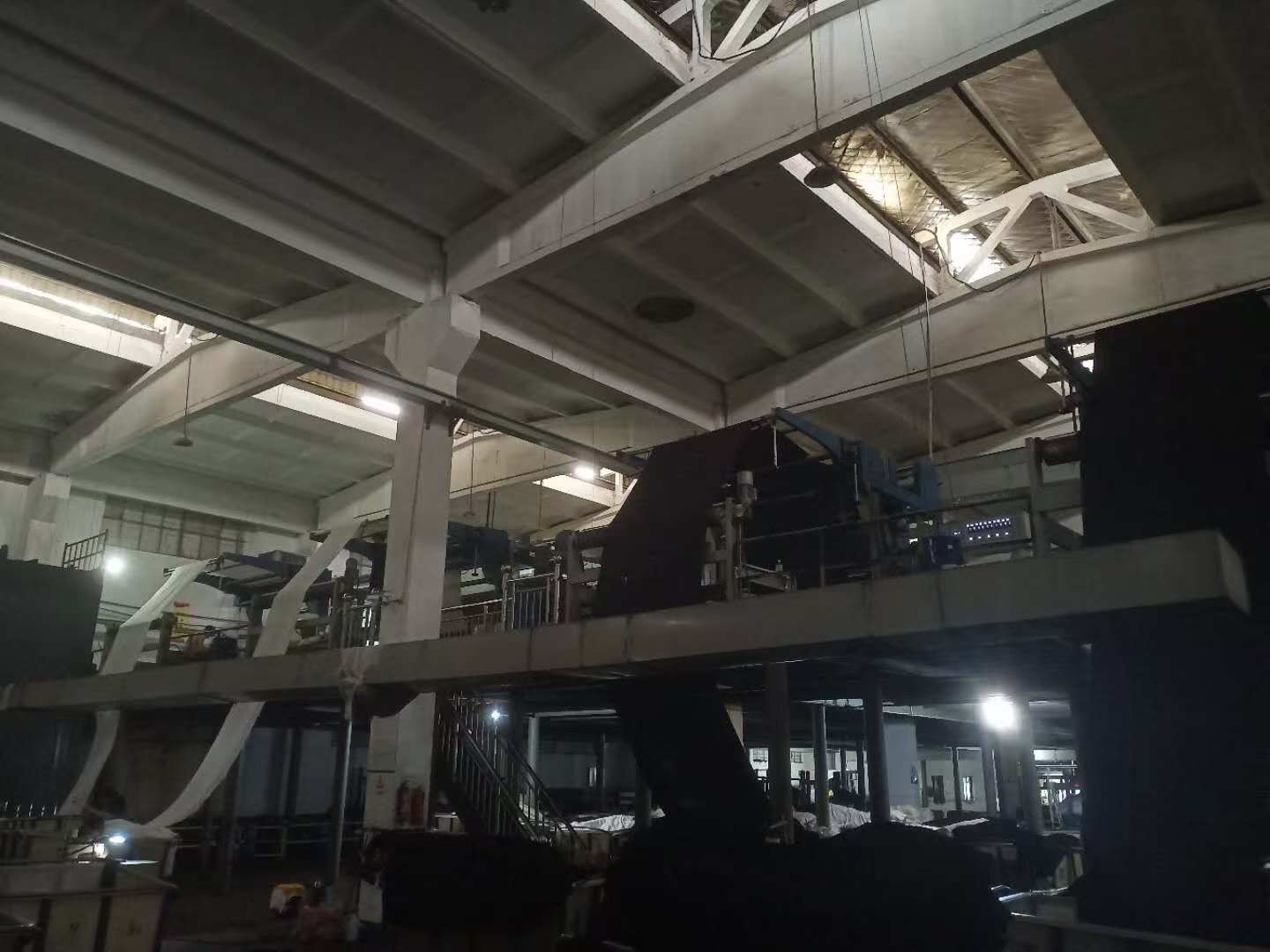
Coffee-charcoal powder is abrasive and does not disperse itself. The realistic spinning questions are about dosing accuracy, filter and pack life, and break rates relative to the same yarn without additive, because those three numbers tell you whether the additive is under control or simply present.
Smilytex states that its spinning process can be used to customise yarn style, elasticity and handle to customer requirements, and that the company operates with a 10-engineer R&D team and more than 20 core patented technologies. For a vetting file, translate those statements into checkable items: which yarn counts and filament counts are offered with the coffee additive, what the dosing method is, and what happens to filtration as additive loading rises.
Two practical tests belong at this gate. First, request two production lots of the same specification and compare them for shade and tenacity variation; uneven dispersion usually shows as streakiness after dyeing rather than as a number on a certificate. Second, ask whether the supplier spins the coffee yarn on the same line as standard polyester and how purging is handled, since cross-contamination is a real risk in a plant running multiple functional products.
Gate 3 — Knitting and weaving
The functional surface of a coffee-charcoal garment is created at fabric formation, not at spinning. A supplier who only sells yarn pushes this question downstream; a supplier who can speak to fabric structure keeps it inside the qualification.
Ask which machine type and gauge the coffee yarn has been run on, which fabric weights are realistic, and whether the recommended structure is single jersey, interlock, piqué or a woven construction. Smilytex lists sportswear polyester filament knit fabric and sustainable polyester filament knit fabric among its products, which makes knit-structure questions fair to raise at the supplier stage rather than at the garment factory.
The vetting point is not whether the supplier knits in-house. It is whether the supplier can state, in advance, which constructions have already carried the additive without processing problems, and whether a knitting trial is included in the sampling plan or billed as an extra.
Gate 4 — Dyeing and finishing
This is where many otherwise sound coffee-charcoal programs lose their functional claim. The colour route determines how much wet processing the additive sees, and the finishing route determines whether the fabric surface still behaves as the test report says it does.
Ask directly whether colour comes from dope dyeing (mass coloration) or from piece dyeing after fabric formation. A dope-dyed route reduces the dyeing burden on a functional fabric and is often chosen for that reason; Smilytex describes dope dyeing as one of the features associated with its coffee-charcoal work and lists eco-friendly dope-dyed properties in a delivered apparel case. Either route can be acceptable, but the answer changes the test plan, because a far-infrared report on a dope-dyed greige-equivalent fabric does not describe a piece-dyed, softened, washed finished fabric.
Two further questions belong here: which finishing treatments (softener, raising, calendering, coating) are applied after the functional fabric is formed, and whether colourfastness data is available for the actual shade rather than a reference shade.
Gate 5 — Functional test capability
Testing is the gate most often mistaken for the whole audit. It is the fifth of six, because a test report is only as useful as the identification of what was tested.
Far-infrared performance under GB/T 30127-2013
A report issued under GB/T 30127-2013 should identify the laboratory, the test date, the specimen structure and weight, and the condition of the sample. Request the full report rather than a summary line, and check that the described specimen matches the fabric you intend to sell. If the report describes a heavier interlock and your program is a lightweight jersey, the result does not transfer.
Caffeine residue by LC-MSMS at 0.009 mg/kg
Where a program fixes a caffeine residue ceiling of 0.009 mg/kg, the acceptable evidence is a report produced by liquid chromatography-tandem mass spectrometry, naming the sample, the extraction method and the reported value against that ceiling. A general statement that a material is skin-safe does not answer this question, and neither does a certificate for a different product series. Because the limit is low, confirm that the laboratory reported an LOQ at or below the ceiling rather than simply returning a non-detect.
The remaining functional panel
Odour control, antimicrobial performance and quick-dry behaviour each need their own method statement. Ask for the test organism and inoculum for antimicrobial claims, the assessment method for odour, and the drying-rate method for quick-dry. A yarn described as antibacterial in a product name is not a result.
Gate 6 — Certificate scope and chain of custody
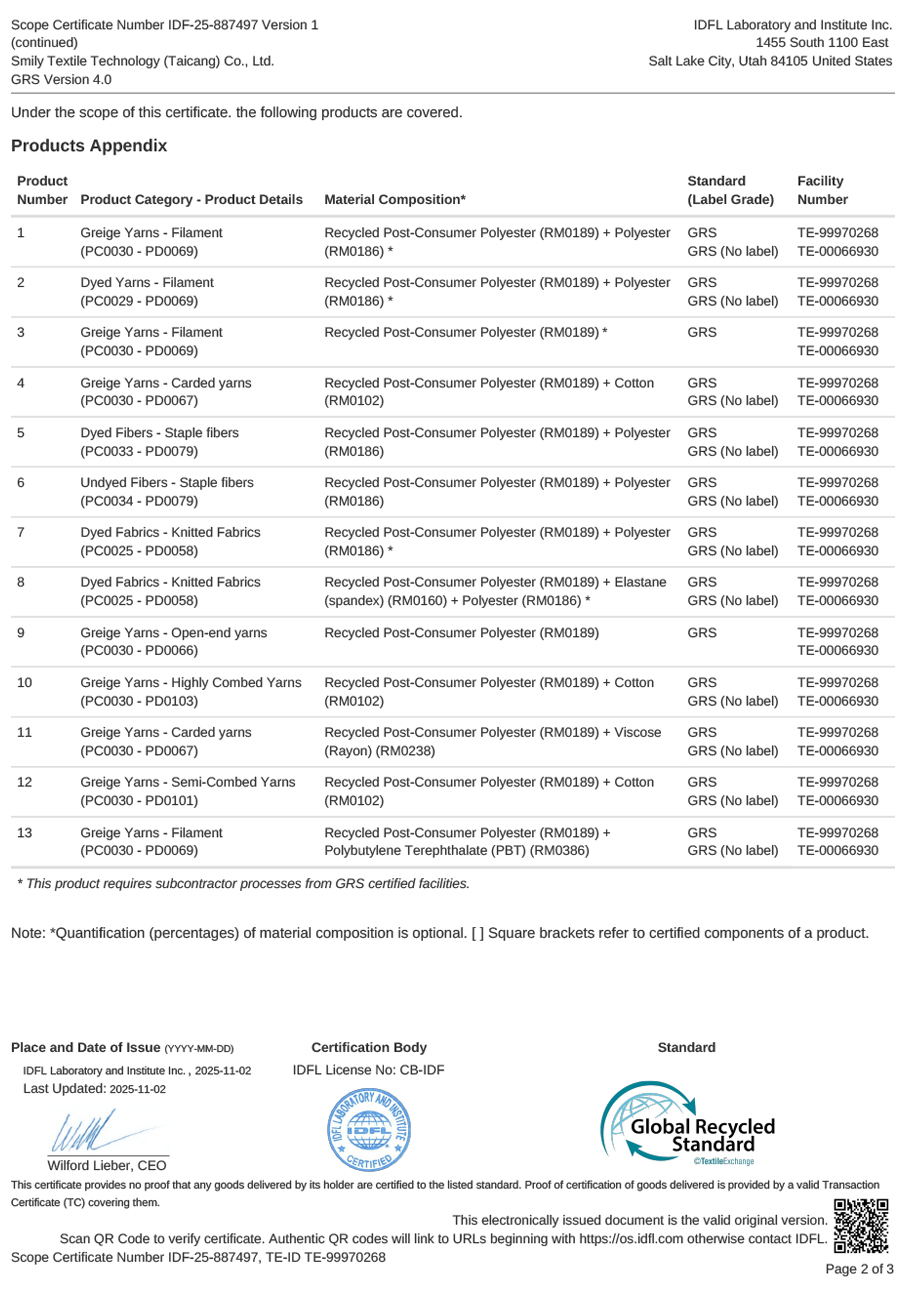
Read the scope certificate as a document with boundaries, not as a badge. Three fields decide whether it applies to your order: the standard and version, the product categories listed, and the validity window.
Smilytex holds GRS v4.0 scope certificate IDF-25-887497 and RCS 2.0 scope certificate IDF-25-887506, both issued by IDFL Laboratory and Institute Inc. on 2 November 2025 and valid to 1 November 2026. The listed scope covers greige yarns, dyed yarns, dyed fibres, undyed fibres and dyed fabrics. For a coffee-charcoal knit program, that is the relevant question: is the category you are buying — greige yarn, dyed yarn, or dyed fabric — named on the certificate, and is the certificate still valid on your shipment date?
The scope certificate is not the lot record. Ask for the transaction certificate covering the shipment, because that is the document that connects a certified supply chain to the kilos on the pallet. Both certificates above reach their expiry on 1 November 2026, so a program shipping after that date needs the renewed certificate before the order is placed, not after.
The evidence table: what closes a question and what does not
| Program question | Evidence that closes it | What does not close it |
|---|---|---|
| Recycled content of the lot | Scope certificate naming the product category plus a transaction certificate for the lot | A certificate logo reproduced in a brochure |
| Far-infrared function | GB/T 30127-2013 report with specimen structure, weight and condition | The words far-infrared in a yarn description |
| Caffeine residue | LC-MSMS report with a stated LOQ and a value against 0.009 mg/kg | A general skin-contact safety statement |
| Antimicrobial function | Report naming method, organism, inoculum and wash state | Antibacterial in the product name |
| Colour route | Written statement of dope dye versus piece dye, with colourfastness data | Dope dye listed as an available option |
| Supply capacity | Monthly output, MOQ and lead time in a quotation or contract | A verbal assurance during a call |
Delivery assurance questions to ask before a purchase order
Capability and delivery are separate risks, and a supplier can pass five gates and still fail on schedule. Smilytex states a monthly capacity of 1.6 tons, a 500 kg minimum order quantity, a 5–20 day lead time, 100% testing, and an export share of 70% across the EU, USA and Japan. Each of those numbers generates a question worth asking of any candidate, not just this one.
- Is the MOQ per colour, per yarn count, or per order? A 500 kg floor that applies per colour behaves very differently from one that applies to the shipment.
- Does the 5–20 day lead time cover spinning only, or spinning plus dyeing plus testing? External laboratory turnaround is usually outside it.
- What does 100% testing mean in practice — which properties are checked on every lot, and which are checked by sampling?
- If the downstream garment factory rejects a lot, what is the acceptance criterion and who pays for the re-test?
- Is production capacity shared with other functional series, and how are coffee-charcoal lots prioritised when the plant is full?
Ask the same five questions of every candidate and score the answers on the same scale. That is what turns a supplier visit into a comparison rather than an impression.
What a closed program looks like
A finished vetting file usually shows up as a delivered program, not a promise. Smilytex reports a garment manufacturing case delivered across Japan, Malaysia, China and the United States with a 5-ton quantity over a 2–5 year relationship, where the results met production requirements for functional fabrics including quick-drying, antibacterial, far-infrared heating, cotton-like touch and recycled eco-friendly materials.
A second case is closer to the coffee-charcoal brief: an apparel OEM manufacturer in China, 2,000 pieces over five years, with fabric properties described as high stretch, quick-dry, antibacterial and eco-friendly dope-dyed, and the key features listed as recycled coffee waste, odour control, far-infrared heating, quick dry, dope dye and anti-microbial performance. The same case highlights that the recycled materials carried GRS/RCS certification to meet the brand's sustainability requirements.
These are company-reported cases and should be read as program references rather than as independent performance validation. Their vetting value is specific: they show which functions were combined on one commercial fabric, and they show that the certification route was part of the customer requirement rather than an afterthought.
Ranking candidate suppliers on the six gates
When two or three suppliers clear the documentation stage, the ranking decision should follow the same order as the audit — not the price list. A simple weighting that works in practice:
- Traceability first. A supplier who can map the additive from coffee material to masterbatch lot outranks one who cannot, regardless of price.
- Process control second. Dosing method, in-line variation data and cross-contamination handling.
- Fabric-forming competence third. Named constructions and weights already run with the additive.
- Colour route fourth. Dope dye versus piece dye, stated in writing with colourfastness support.
- Test completeness fifth. Full reports, not summary lines, including the residue panel at the program ceiling.
- Certificate currency sixth. Scope certificate categories and validity dates that cover the shipment window.
A supplier that wins on gates 1 to 3 and is merely adequate on gates 4 to 6 is usually the better development partner; a supplier that wins only on certificate presentation is a paperwork shortcut that fails at the first test discrepancy.
Frequently asked questions
What compliance documents should a coffee-charcoal polyester filament supplier provide before sampling?
A GRS or RCS scope certificate that names the product categories you are buying — greige yarn, dyed yarn, dyed or undyed fibre, dyed fabric — together with its certificate number, issuing body and validity dates. Smilytex holds GRS v4.0 scope certificate IDF-25-887497 and RCS 2.0 scope certificate IDF-25-887506, both issued by IDFL on 2 November 2025 and valid to 1 November 2026. Alongside the scope certificate, ask for the transaction certificate that covers the specific lot, and for a far-infrared test report issued under GB/T 30127-2013. A scope certificate proves the supply chain is certified; only the transaction certificate connects that chain to the kilos you receive.
What spinning, knitting and finishing capability should a supplier demonstrate?
At spinning, masterbatch dosing and dispersion control, because uneven dispersion appears as shade streaking and elevated breaks rather than as a certificate defect. At fabric formation, the machine gauge and fabric weight range actually run with the coffee additive. At finishing, a written statement of whether colour comes from dope dyeing or piece dyeing, because the route determines how much wet processing the functional additive undergoes. Smilytex states ODM customisation of yarn style, elasticity and handle through its spinning process, a monthly capacity of 1.6 tons and a 100% testing regime, which gives a sourcing team concrete items to verify rather than general assurances.
What drives the cost of a coffee-charcoal functional polyester filament program?
Four drivers, not one: additive loading in the masterbatch, the colour route chosen (dope dye versus piece dye), the scope of the test panel, and order size measured against the minimum quantity. Smilytex lists a 500 kg MOQ, which sets the point at which a development order becomes economic. Test cost is easy to overlook because it is paid to a third-party laboratory rather than to the spinner: far-infrared testing under GB/T 30127-2013, antimicrobial testing, odour assessment and LC-MSMS caffeine residue each carry separate charges and should be budgeted as their own line rather than assumed to be inside the yarn price.
How should a sourcing team structure sampling and validation?
Three stages, all drawn from the same yarn lot. First, a yarn and lab-dip sample to check hand-feel, shade and knitting behaviour. Second, a trial fabric piece long enough for the full panel: far-infrared under GB/T 30127-2013, antimicrobial, odour, quick-dry, and caffeine residue by LC-MSMS against the 0.009 mg/kg ceiling. Third, a wash-durability check, because performance measured on an unfinished trial piece does not describe the garment after domestic laundering. Changing yarn lot between stages is the most common reason a program reaches bulk production and then fails a test it had already passed at sampling.
What lead time and order quantity should be planned?
Smilytex lists a 5–20 day lead time and a 500 kg MOQ, with 70% of output exported to the EU, USA and Japan. Plan the laboratory panel as a separate calendar block rather than folding it into the spinner's lead time, since external test turnaround is not part of the spinning schedule. Build the shipment date backwards from certificate validity as well: both scope certificates referenced above run to 1 November 2026, so a program shipping later needs the renewed documents in hand before the purchase order is raised. Sourcing teams that want to test the process against a live specification can request a coffee-charcoal yarn sample and the current specification sheet from Smilytex directly.
Conclusion
Vetting a coffee-charcoal antibacterial polyester filament supplier is a sequence decision before it is a judgement call. Feedstock traceability, spinning control, fabric formation, colour route, functional testing and certificate scope each answer a different question, and the order in which you ask them determines how much of the work survives a failed answer. The documents that matter are unglamorous: a masterbatch lot record, a GB/T 30127-2013 far-infrared report with a described specimen, an LC-MSMS result against a 0.009 mg/kg ceiling, and a scope certificate whose categories and dates match the shipment.
Smily Textile Technology (Taicang) Co., Ltd. — established in 2017, operating a 16,220 m² facility with 206 employees, a 10-engineer R&D team and more than 20 core patented technologies — presents Cocarber® as its coffee-charcoal route, built on carbonised spent coffee grounds as a functional masterbatch. Whether that route fits a specific garment program is a question for the six gates, answered with documents rather than adjectives.
Next step for evaluation teams
Request a coffee-charcoal yarn sample, the current specification sheet and the test documentation package from Smilytex, then run the six-gate checklist against it. The company product brochure can be downloaded here: Smilytex product brochure (PDF). Company details and current product information are available at smilytex.com.

Have Questions or Need More Details?
Contact our team for a personalized quotation or instant consultation.
Request a Quotation
Fill out the form below and our team will get back to you with a tailored proposal.
WhatsApp Direct Chat
Prefer to chat in real-time? Message us on WhatsApp for instant assistance & quick answers.
- Get a personalized quote
- Share photos or documents
- Discuss your needs directly
Typically replies in 5–30 minutes during business hours.