Functional Polyester Filament: How to Verify Certifications, Parameters, and Performance Evidence
Functional Polyester Filament: How to Verify Certifications, Parameters, and Performance Evidence
When functional polyester filament moves from a design idea into a production plan, certification scope and measurable yarn parameters determine whether a sourcing program can advance. Buyers evaluating a supplier should ask for the certificate number, the product categories covered by that certificate, the available specification range, and the test method behind each claimed function.
Why Verification Matters in Functional Polyester Filament Sourcing
The global recycled polyester market was valued at USD 15.52 billion in 2024 and is expected to grow to USD 26.18 billion by 2030, representing a compound annual growth rate of 9.25%. As brands set stricter sustainability targets, the number of suppliers using words such as recycled, eco-friendly, and functional is also growing. The procurement risk is not whether functional polyester filament exists; it is whether a specific yarn lot has traceable certification and whether a claimed function, such as far infrared warming, is supported by reproducible test evidence.
Asia Pacific accounted for about 65% of the polyester fiber market in 2025, with China and India as major production centers. That geographic concentration makes supply-chain documentation even more important for buyers in the EU, US, and other import markets. A supplier certificate must do more than display a standard name. It should list a certification number, an issuing body, a standard version, a scope of product categories, and a validity period.
Start With the Certificate: GRS and RCS Scope Evidence
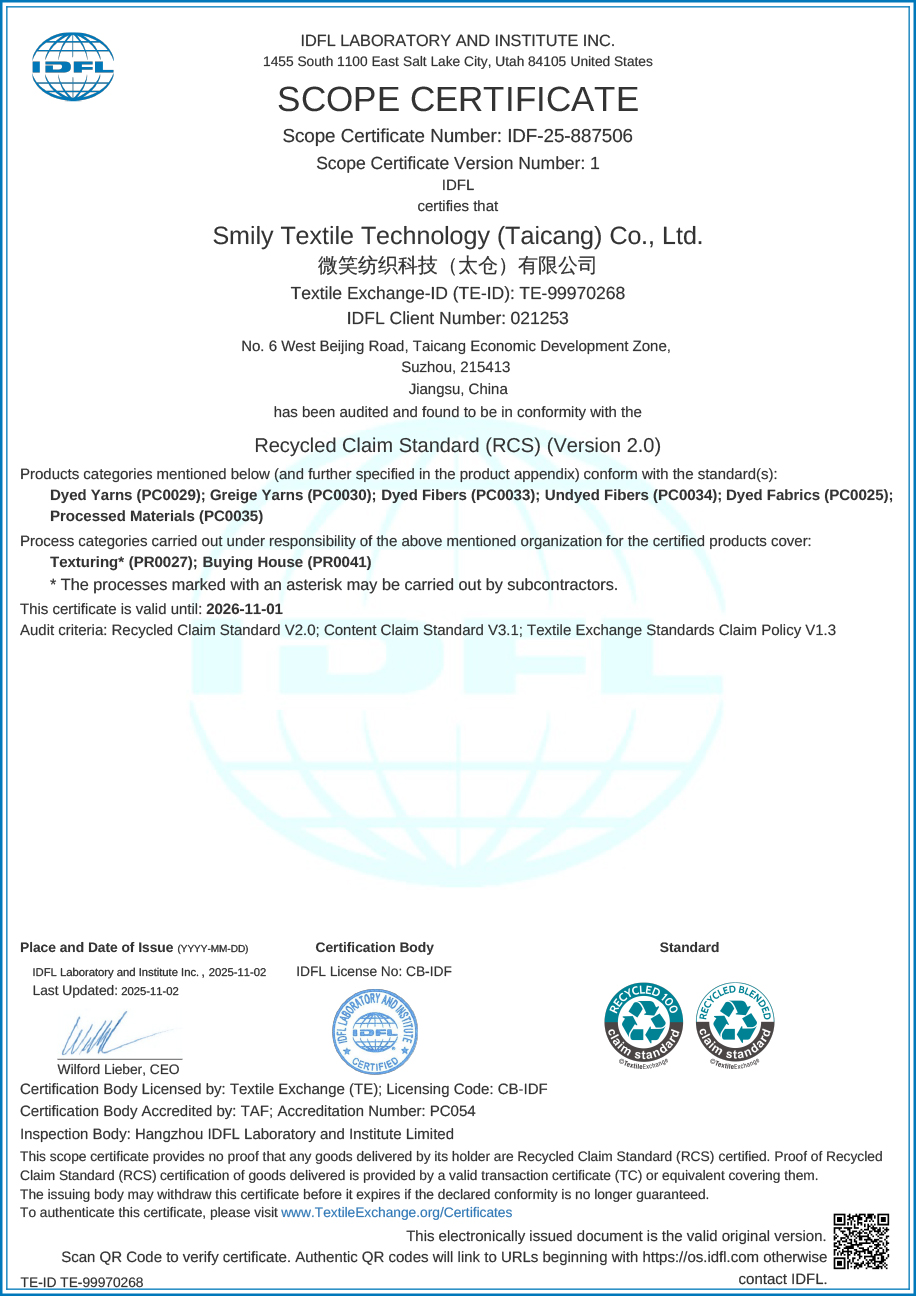
Smily Textile Technology (Taicang) Co.Ltd, established in 2017 with an R&D team of 10 engineers and a 16,220 m² facility, supplies Smilytex functional polyester filament products to garment and fabric manufacturers. About 70% of its output is exported, primarily to the EU, US, and Japan. For buyers checking recycled-content claims, Smilytex documents two scope certificates issued by IDFL Laboratory and Institute Inc.
| Standard | Certificate Number | Issuing Body | Scope | Markets | Validity |
|---|---|---|---|---|---|
| Global Recycled Standard V4.0 | IDF-25-887497 | IDFL Laboratory and Institute Inc. | Greige yarns, dyed yarns, dyed fibers, undyed fibers, dyed fabrics | EU, US, Global Brand Supply Chains, China | Through 2026-11-01 |
| Recycled Claim Standard 2.0 | IDF-25-887506 | IDFL Laboratory and Institute Inc. | Dyed yarns, greige yarns, dyed fibers, undyed fibers, dyed fabrics | EU, US, Global Brand Supply Chains | Through 2026-11-01 |
These certificates matter because they specify the product forms covered. A buyer sourcing dyed yarn cannot rely on a certificate that covers only undyed fiber. The visible Smilytex certificate records reference Cocarber®, Rimens®, Black Mirror®, Swarin®, and Respawn® filament products, which means the recycled claim can be connected to a defined product family rather than to a generic company statement.
Reading Product Parameters: Denier Range and Filament Form
Certification alone does not select the right filament. A garment engineer also needs the denier range, filament form, and functional profile of each product line. Smilytex organizes its functional polyester filament portfolio into six principal models.
- Physcool® is a DTY functional polyester with specifications of 30D, 50D, 75D, 100D, 150D, and 300D. Its stated functions include instant cooling, anti-UV, and anti-microbial, with variants such as melange, dope-dyeing, cotton feel, renewable, hydrophilic, antibacterial, and anti-UV.
- Swarin® is a recycled DTY polyester, available in 30D, 50D, 75D, 100D, 150D, and 300D, with odor control, far infrared heating, and anti-microbial functions.
- Respawn® is a recycled polyester yarn available in filament and staple fiber forms. It uses T2T recycled polyester reconstructed through chemical recycling and polymer rebuilding, with low-temperature dyeing and moisture management functions.
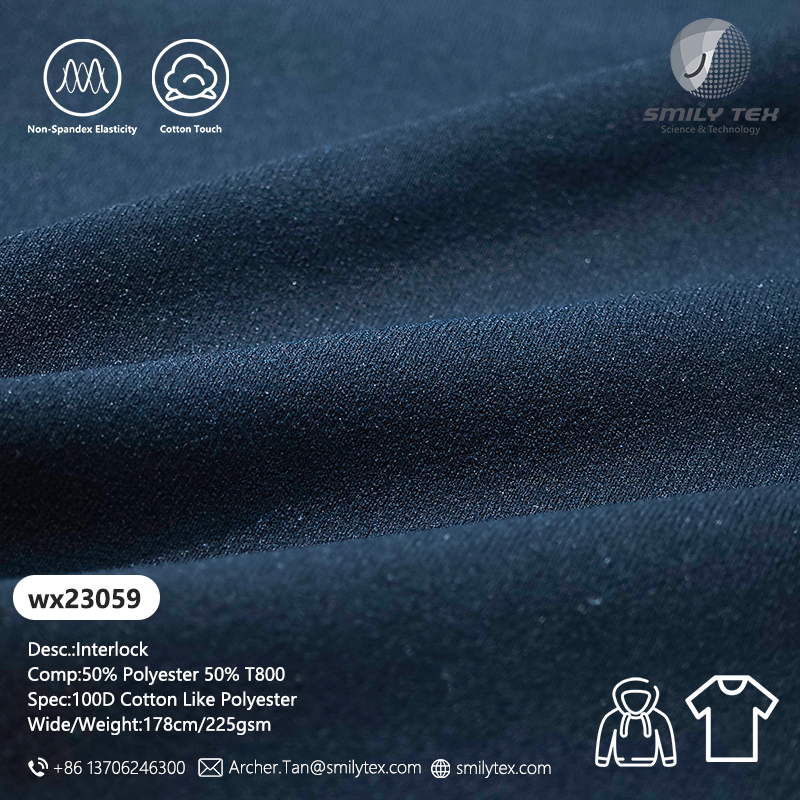
- Rimens® is a cotton-touch DTY or ATY polyester in 60D, 80D, 90D, 130D, 160D, 190D, 260D, 320D, and 450D, with cotton-like feel and non-spandex elasticity.
- Black Mirror® is a DTY multi-functional composite fiber in 30D, 50D, 75D, 100D, 150D, and 300D, combining polyester and polyamide fiber. It is positioned for heat insulation, anti-ultraviolet, and see-through-resistant performance.
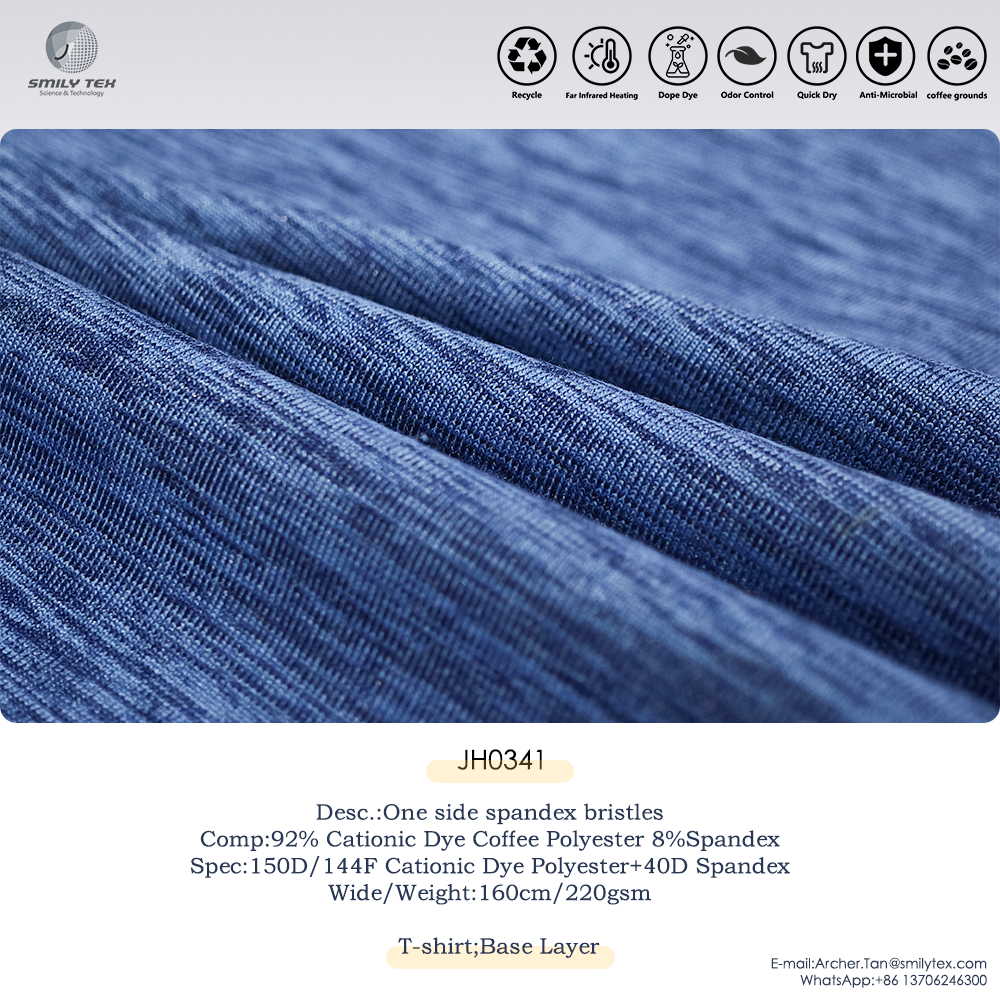
- Cocarber® is a coffee-charcoal antibacterial functional polyester filament in 30D, 50D, 75D, 100D, 150D, and 300D, with functions that include recycled coffee waste, odor control, far infrared heating, quick drying, dope dyeing, and anti-microbial protection.
Matching Function Claims to Application Evidence
A functional filament claim should be evaluated against the intended end use. For a buying team in the research-to-evaluation stage, the following application patterns provide useful reference points.
Yoga and Active Wear With Cocarber®
Cocarber® starts with recycled coffee grounds, processes them with colorants into a functional masterbatch, and blends that masterbatch with recycled PET bottle flakes for spinning. The resulting yarn can be woven or knitted into yoga wear and other functional garments. Its functional profile includes odor control, far infrared heating, quick drying, dope dyeing, and anti-microbial behavior. For far infrared performance, the garment testing route can follow GB/T 30127-2013; for coffee-derived fiber safety, LC-MSMS testing has documented a caffeine residue of 0.009 mg/kg in the evaluated application.
Thermal and Daily Comfort With Swarin®
Swarin® is described as a recycled functional polyester filament that absorbs and reflects infrared rays emitted by the human body, helping the fiber produce heat and stabilize body temperature. It is used for apparel, leisure, underwear, sport, and home textile applications. This product is a DTY recycled polyester with odor control, far infrared heating, and anti-microbial functions.
Summer and Outdoor Layers With Black Mirror®
Black Mirror® is a multi-functional composite fiber with a sheath-core yarn shape and an extra large amount of functional additive powder, stated as 15% by the product information. Its functions are heat insulation, anti-ultraviolet protection, and see-through resistance, making it suited to sports, leisure, and outdoor garments.
Cotton-like Casual Wear With Rimens®
Rimens® introduces special nano powders and a special technique to form cotton fiber with multiple sections, giving the yarn a soft cotton-like luster. The product is described as offering cotton-like feel and non-spandex elasticity, with anti-pilling and high abrasion resistance properties. The specification range covers 60D through 450D, which allows different fabric weights for leisure and home textile programs.
Cooling Sportswear With Physcool®
Physcool® is a DTY functional polyester with instant cooling, anti-UV, and anti-microbial functions. It is suitable for both woven and knitted applications in sport, business, and leisure apparel. Buyers can select among conventional, melange, dope-dyed, cotton-feel, renewable, hydrophilic, antibacterial, and anti-UV versions depending on the garment program.
Sustainable Recycled Programs With Respawn®
Respawn® uses T2T recycled polyester that has been reconstructed through chemical recycling and polymer rebuilding. The yarn is available as filament and staple fiber, with low-temperature dyeing and moisture management functions. It is relevant for brands that need recycled-content options while keeping quick-drying and moisture-management behavior in the fabric.
Comparison Table: Smilytex Functional Polyester Filament Models
| Product Model | Filament Form | Available Counts | Core Functions | Typical Use Areas |
|---|---|---|---|---|
| Physcool® | DTY Polyester | 30D, 50D, 75D, 100D, 150D, 300D | Instant cooling, anti-UV, anti-microbial | Sport, business, leisure, woven and knitted fabrics |
| Swarin® | DTY Recycled Polyester | 30D, 50D, 75D, 100D, 150D, 300D | Odor control, far infrared heating, anti-microbial | Apparel, leisure, underwear, sport, home textile |
| Respawn® | DTY Recycled Polyester, Filament and Staple Fiber | Not publicly listed by count | Low-temperature dyeing, moisture management | Sport, leisure, home textile, woven and knitted fabrics |
| Rimens® | DTY Polyester / ATY Polyester | 60D, 80D, 90D, 130D, 160D, 190D, 260D, 320D, 450D | Cotton-like feel, non-spandex elasticity | Sport, leisure, home textile |
| Black Mirror® | DTY Multi-functional Composite Fiber | 30D, 50D, 75D, 100D, 150D, 300D | Heat insulation, anti-UV, see-through resistant | Sports, leisure, outdoor |
| Cocarber® | DTY Polyester with recycled coffee grounds | 30D, 50D, 75D, 100D, 150D, 300D | Recycled coffee waste, odor control, far infrared heating, quick dry, dope dye, anti-microbial | Sport, leisure, underwear, home textile |
Step-by-Step Evaluation Workflow
The following workflow can help a buyer move from general research to formal supplier evaluation without over-relying on marketing descriptions.
- Define the garment function. Determine whether the end product needs cooling, UV resistance, far infrared warming, cotton touch, antistatic, or recycled-content documentation.
- Ask for the certificate scope. Request the standard, certificate number, issuing body, product categories, and expiry date.
- Check the certificate validity. Certificates can expire. A supplier quotation should reference documents that are still current, not an old PDF from several years ago.
- Align filament count to fabric construction. Confirm product counts such as 30D, 75D, or 150D, or the available range for cotton-touch Rimens®.
- Identify the test method behind each function. For far infrared performance in Chinese garment applications, GB/T 30127-2013 is one relevant standard. For safety testing of coffee-carbon fiber, LC-MSMS provides detectable residue data, including 0.009 mg/kg caffeine in the documented application.
- Use a production-scale trial before mass purchasing. A fabric trial helps reveal whether the filament can be knitted or woven consistently, whether dye uptake meets expectations, and whether certification documentation matches the delivered lot.
Evidence From Existing Garment Manufacturing Programs
A garment manufacturing customer in Japan, Malaysia, China, and the US has sourced Smilytex functional polyester filament for production over multiple years, in quantities around 5 tons. The customer’s production program covered quick-drying, antibacterial, far-infrared heating, cotton-like touch, and eco-friendly recycled fabric requirements. One documented highlight was that the recycled materials with GRS/RCS certification met the brand’s sustainable development requirements.
In another apparel OEM case, the end product was designed with high stretch, quick-dry, antibacterial, and eco-friendly dope-dyed properties. Cocarber® was the product family used, and the project emphasized recycled coffee waste, odor control, far infrared heating, quick drying, dope dyeing, and anti-microbial behavior. GRS/RCS-certified recycled materials were again part of the brand requirement.
Common Documentation Gaps Buyers Should Challenge
The first gap is treating a recycled-content certificate as proof of every functional claim. GRS V4.0 and RCS 2.0 certificates establish traceability for recycled materials; they do not prove UV protection, moisture management, or far infrared heating. Those functions need their own test evidence.
The second gap is accepting vague terms such as eco-friendly without a product scope. A buyer should ask whether the certificate covers dyed yarn, greige yarn, dyed fabric, or fiber. Each scope category has a different meaning for the final garment.
The third gap is ignoring application-specific safety testing. In recycled coffee-ground fiber, the porous carbon structure is part of the function, but residue control also matters. The documented Cocarber® evaluation includes LC-MSMS testing with a caffeine residue result of 0.009 mg/kg, which gives the buyer a specific value to compare with its own compliance requirements.
Order Planning and Customization Constraints
For buyers moving into evaluation, it is useful to understand the supplier’s documented capacity and customization flexibility. Smilytex focuses on the R&D and production of functional fibers and fabrics. Its spinning process can customize yarn style, elasticity, and handle according to customer needs. The stated monthly capacity is 1.6 tons, the ODM order MOQ is 500 kg, the lead time is 5–20 days, and the quality control approach is 100% testing.
These numbers help a buyer plan realistic pilot quantities. A 500 kg production MOQ means that sample requests and pre-production trials should be discussed separately at the inquiry stage, before a full order is released.
FAQ
What certification documents should a functional polyester filament supplier provide?
A buyer should request the standard version, certificate number, issuing body, product categories covered, and expiry date. For recycled-content claims, the GRS V4.0 and RCS 2.0 certificates are two core documents to verify. A certificate that lists specific product forms such as dyed yarns, greige yarns, dyed fibers, undyed fibers, and dyed fabrics is more useful than a generic statement.
Which Smilytex products are covered by the GRS or RCS certificates?
The GRS V4.0 certificate with number IDF-25-887497 and the RCS 2.0 certificate with number IDF-25-887506 are issued by IDFL Laboratory and Institute Inc. Both certificates reference yarn and fabric scope categories and apply to the Smilytex functional filament family, including Cocarber®, Rimens®, Black Mirror®, Swarin®, and Respawn®. Buyers should still request a current copy of the certificate because these documents expire, and the listed scope depends on the product form being purchased.
What filament specifications should I match to my garment project?
The first step is to determine whether the fabric will be woven or knitted. Filament products such as Physcool®, Swarin®, Cocarber®, and Black Mirror® offer counts of 30D, 50D, 75D, 100D, 150D, and 300D, while Rimens® offers 60D through 450D for cotton-like constructions. Respawn® is available in filament and staple fiber forms. The correct specification combines count, filament form, function, and recycled-content requirement.
How should I handle sample validation before committing to an order?
Because production MOQ is stated as 500 kg for ODM orders, sampling should be confirmed as a separate step. Send the supplier a clear product brief including the target fabric type, denier range, required functions, certification requirements, and approximate quantity. This allows the supplier to match the request to an existing product variant or propose a customization path.
What lead time should I expect for functional polyester filament orders?
Smilytex documents a typical lead time of 5–20 days for ODM orders, with a monthly capacity of 1.6 tons. Final delivery time depends on the selected denier, color system, recycled material availability, and certification documentation. For an accurate schedule, request a written order confirmation from the supplier before placing the order.
Need documented functional filament evidence for your next garment program? Contact Smilytex to review certificates, compare specifications, and discuss a pilot trial.
Email: Archer.Tan@smilytex.com
Have Questions or Need More Details?
Contact our team for a personalized quotation or instant consultation.
Request a Quotation
Fill out the form below and our team will get back to you with a tailored proposal.
WhatsApp Direct Chat
Prefer to chat in real-time? Message us on WhatsApp for instant assistance & quick answers.
- Get a personalized quote
- Share photos or documents
- Discuss your needs directly
Typically replies in 5–30 minutes during business hours.