Application Guide: Using Far-Infrared Heating Functional Polyester in US Apparel Projects
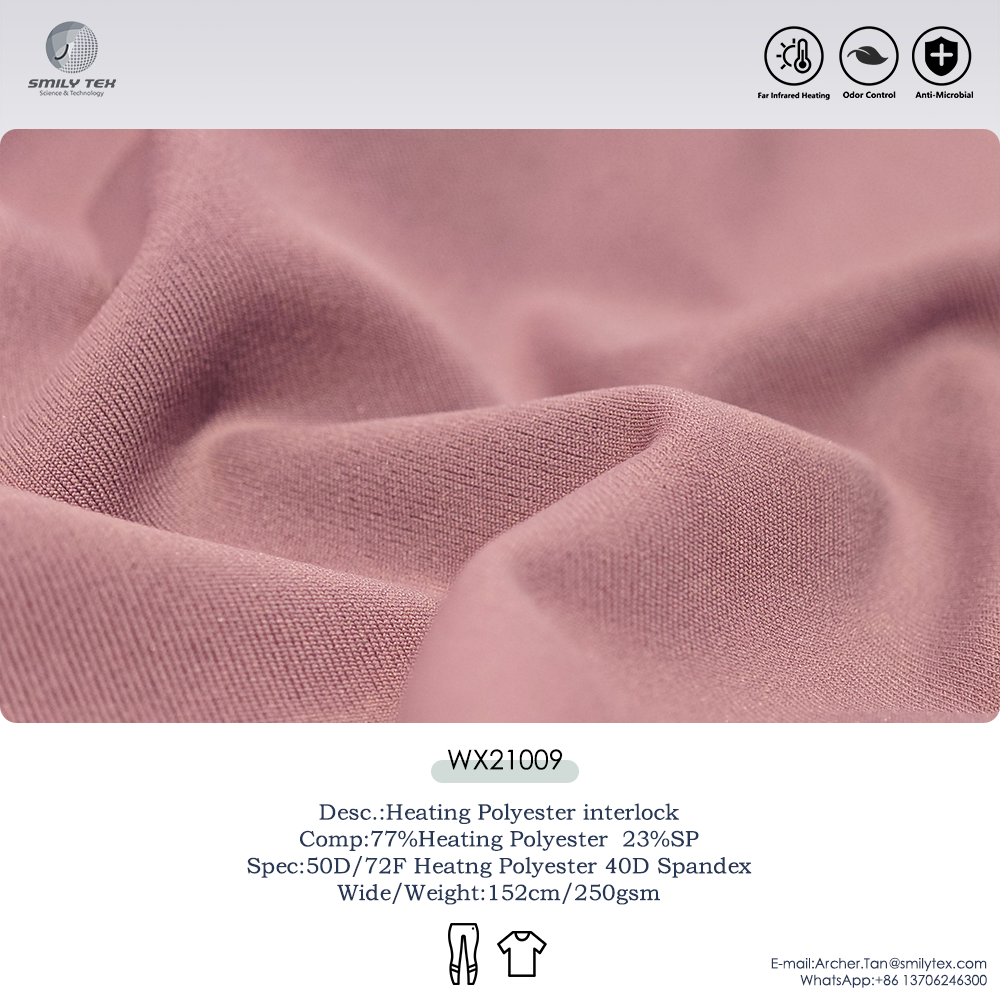
Swarin® WX21009 — a DTY recycled polyester built on a far-infrared heat mechanism.
Far-infrared heating functional polyester is a filament yarn engineered to absorb and reflect the infrared rays emitted by the human body, so that the fiber itself generates heat, compensates for heat lost to the external environment, and helps the garment maintain a relatively stable body temperature. In a US apparel program, that mechanism is usually paired with heat insulation, anti-ultraviolet protection and see-through resistance — three properties that decide whether a lightweight thermal garment is actually wearable.
This application guide is written for US apparel developers, sourcing managers and brand owners specifying a far-infrared heating route for an upcoming season. It explains the operating principle, the composite-yarn engineering behind it, the test and compliance anchors worth requesting from a supplier, and a step-by-step workflow that runs from garment brief to validated sample.
Product references throughout come from Smilytex (Smily Textile Technology (Taicang) Co., Ltd., www.smilytex.com), a functional textile materials company established in 2017 that specializes in the research and development and sales of functional fiber and functional fashion fabrics. Its major markets are the EU, USA and JP, and export business accounts for approximately 70% of total sales — which is why the reference points below are written for US garment programs rather than for a domestic Chinese brief.
The Problem US Apparel Projects Are Trying to Solve
Warmth retention in modern US apparel is a weight problem before it is a temperature problem. Consumers expect a base layer, legging or mid-layer to feel thin, to layer cleanly under a shell, and to stay wearable in a car or an office — while still delivering thermal comfort during the cold parts of the day. Four specific constraints follow from that expectation.
- Warmth without bulk. A thermal program that depends on loft or heavy fleece cannot deliver a second-skin fit, and it cannot be merchandised in the same way as a technical base layer.
- Opacity in light colors and fine-gauge knits. The thinner the fabric, the more likely the body is to show through — and light, neutral and pastel palettes are exactly where the problem becomes visible.
- UV exposure in the same garment. Outdoor training, trail and commuting programs overlap with the cold-weather range, so anti-ultraviolet performance is frequently requested alongside thermal performance rather than in a separate style.
- Claim substantiation. A US brand that markets warming performance or recycled content needs documentation that a lab, a retailer or a compliance reviewer can actually read. That requirement shapes which yarn route a project should choose, and it is the reason this guide lists test methods and additive loadings next to the specifications.
Stated plainly: the buyer need is not “a warmer yarn.” It is a yarn that generates warmth from the wearer, holds that warmth inside a thin construction, keeps a light-colored fabric opaque, blocks ultraviolet radiation, and arrives with evidence.
Industry Background: Where Functional Polyester Filament Demand Sits
Polyester remains the volume base of the performance apparel supply chain, and the demand curve for functional variants is being pulled upward from both the apparel and the sustainability side.
- The global polyester fiber market was valued at USD 82.07 billion in 2025 and is projected to reach USD 148.11 billion by 2034 (Vertex AI / Industry Analysis).
- The polyester filament yarn market specifically was estimated at USD 106.4 billion in 2024, with growth projected at a 3.72% CAGR until 2035 (Market Research Future).
- Asia Pacific held a 65% share of the polyester fiber market in 2025, led by China and India (Vertex AI / Industry Analysis).
- The recycled polyester market was valued at USD 15.52 billion in 2024 and is expected to reach USD 26.18 billion by 2030, a 9.25% CAGR (Grand View Research).
- Athleisure preference for moisture-wicking and antimicrobial polyester blends is cited as a primary market trend for 2024–2026 (Mordor Intelligence).
A note on scope: published market sizes differ depending on whether a report counts total polyester fiber or filament yarn specifically, and the year of the estimate differs as well. Buyers comparing headline figures should compare the underlying definitions first, not the numbers alone.
On the supply side, the industry is anchored by large integrated producers. Indorama Ventures, Reliance Industries, Toray Industries and Teijin Limited are among the major companies in polyester filament yarn. Below that tier sits a specialist layer of developers whose value is the functional formulation itself — the additive package, the composite cross-section, and the ability to match one function to one garment project without over-engineering the fabric.
Smilytex operates in that specialist layer. The company is based at No.6 Weast Beijing Road, Taicang City, Jiangsu Province, China, runs a manufacturing facility of 16,220 m², employs approximately 206 staff, and maintains an R&D team of 10 engineers and professionals. Its documented annual production capacity is approximately 20 tons, and it holds more than 20 core patented technologies, including authorized invention patents, authorized utility model patents and design patents. The product range covers functional polyester and nylon filament — including far infrared thermal retention, coffee charcoal antibacterial, moisture permeable, ultra matte, anti see through hydrophilic, instant cooling and recycled variants — along with knit fabrics for sportswear and sustainable applications.
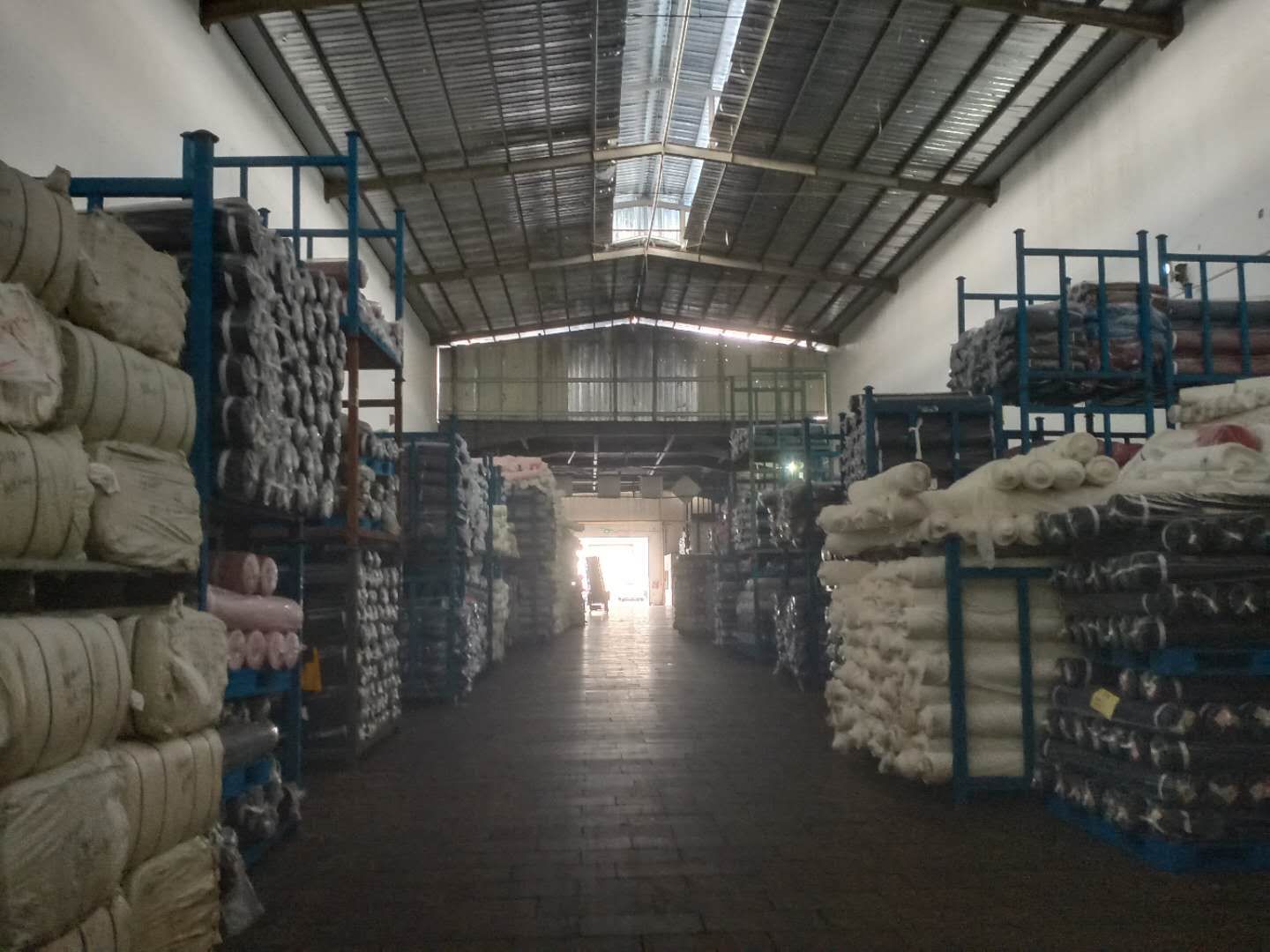
Functional filament production is only useful to a US brand when the yarn function survives spinning, knitting or weaving, finishing and garment making.
How Far-Infrared Heating Functional Polyester Works in a Garment
Far-infrared heating in a polyester filament is a fiber-level mechanism, not a surface coating. The function is delivered by the way the polymer and its additives interact with the infrared radiation a human body emits at rest and in motion. Three routes in the same portfolio reach that territory, and they are not interchangeable.
Mechanism 1: Absorbing and reflecting body infrared (Swarin®)
Swarin® is a DTY recycled polyester whose primary material base is DTY Recycle Polyester (Far-Infrared Heat). Its operating principle is direct: the yarn absorbs and reflects the infrared rays emitted by the human body, so that the fiber itself generates heat, compensates for the loss of heat generated by the external environment, and maintains relatively stable body temperature.
The documented functional set for Swarin® is odor control, far infrared heating and anti-microbial performance. Available denier specifications are 30D, 50D, 75D, 100D, 150D and 300D, and the intended application areas are apparel, leisurewear, underwear, sportswear and home textile. Because the mechanism works on the wearer’s own emission rather than on an external heat source, it behaves as a passive thermal layer: the garment does not need to warm up before it starts contributing.
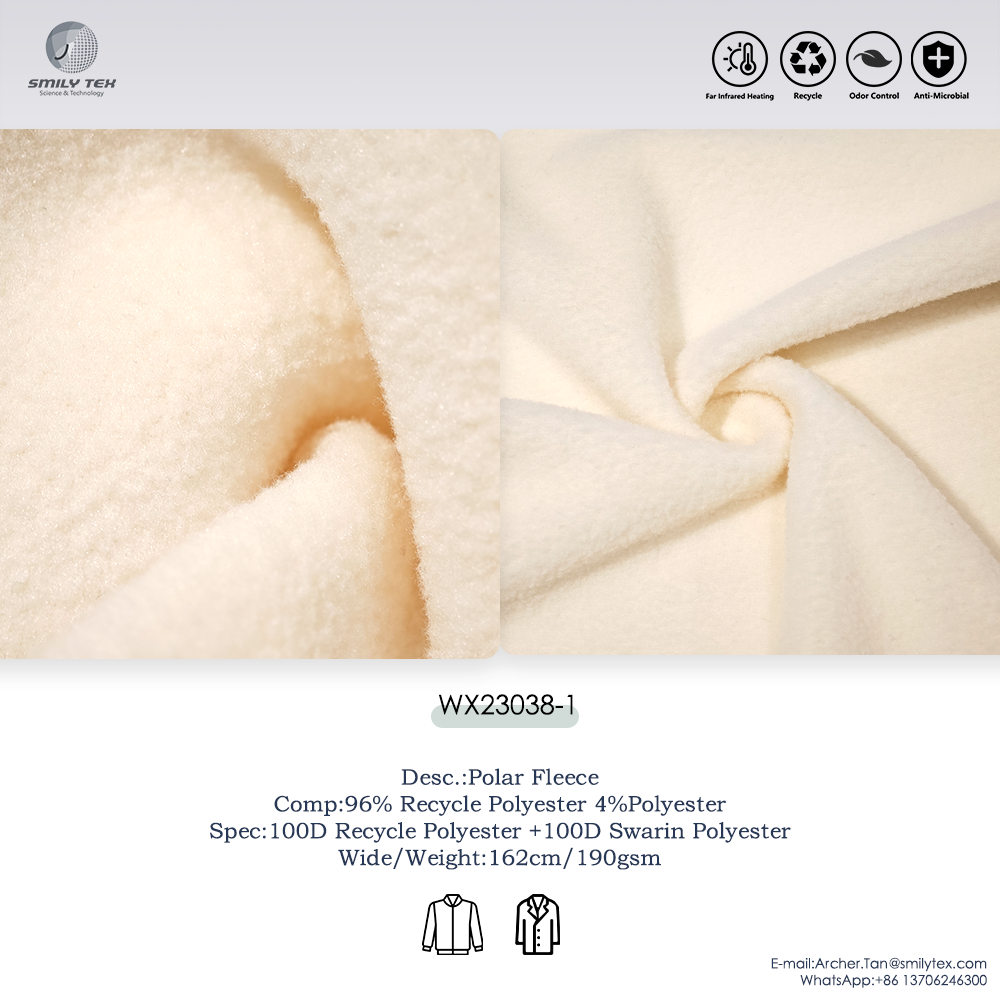
Swarin® WX23038-1 in light beige — the color range matters, because a thermal program is usually built in wearable neutrals.
Mechanism 2: Heat insulation, anti-ultraviolet and see-through resistance (Black Mirror®)
Where the heating mechanism retains warmth, an insulation mechanism slows heat loss. Black Mirror® is a multi-functional composite fiber that combines polyester fiber and polyamide fiber, with a unique fiber shape and an extra large amount of functional additives. Two technical anchors define it, and both are worth writing into a specification sheet:
- Sheath-core composite yarn shape — a bicomponent cross-section rather than a plain round filament.
- An extra large amount of functional additive powder: 15%.
The documented functions of Black Mirror® are heat insulation, anti-ultraviolet and see-through resistance. It is available in 30D, 50D, 75D, 100D, 150D and 300D, is suitable for both woven and knitted applications, and is positioned for sports, leisure and outdoor use. Garment applications of this type are common in the United States.
The practical significance of the sheath-core construction is what it does for the additive package. When functional powder is loaded at 15% and carried inside a composite cross-section, the function is part of the filament rather than a topical finish — which is what a US brand needs when the property has to survive knitting, dyeing and garment finishing, and when the “anti see through” claim has to hold on a pale colorway.
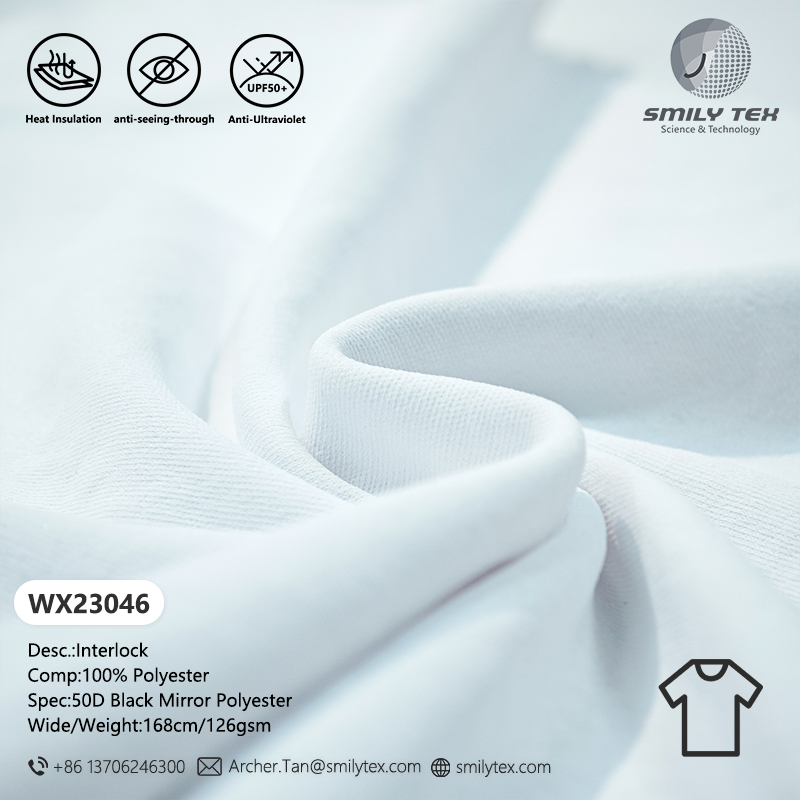
Black Mirror® WX23046-1 in white — heat insulation, anti-ultraviolet and see-through resistance in the same composite filament.
Mechanism 3: Recycled coffee-ground far infrared (Cocarber®)
Cocarber® reaches the same far-infrared territory through a recycled feedstock. The manufacturing route starts with recycled coffee grounds, which are processed together with colorants into a functional masterbatch and then blended with recycled PET bottle flakes for spinning. That route gives the yarn a dope-dyed color system while reducing the need for conventional dyeing, which helps save energy and resources.
The functional logic is structural rather than additive. The porous structure of coffee carbon fiber provides high adsorption, which is how the deodorization effect is achieved; and after low temperature carbonization, the coffee grounds become a special porous structure that delivers natural far infrared, heat storage and warmth without adding any chemical additives. The full documented function set is recycled coffee waste, odor control, far infrared heating, quick dry, dope dye and anti-microbial, in 30D, 50D, 75D, 100D, 150D and 300D, for sport, leisure, underwear and home textile applications. Material variants include bamboo charcoal, coconut charcoal, China-hemp charcoal, coffee charcoal, dope-dyeing, cotton-feeling, renewable and hydrophilic Cocarber.
Because this route is used in recycled coffee-ground-based functional masterbatch and recycled polyester projects, it carries its own verification package: projects reference GB/T 30127-2013 for far infrared performance together with LC-MSMS testing for caffeine residue at 0.009 mg/kg. For a US buyer, that pair of references answers two different questions — does the thermal function exist, and is the recycled coffee-ground input clean.
Supporting functions around the thermal core
A US apparel range rarely needs thermal performance alone. Three further lines from the same portfolio cover the adjacent requirements, and using them alongside a heating yarn usually reduces the number of suppliers a program has to qualify.
- Physcool® — instant cooling, anti-UV and anti-microbial functions in 30D, 50D, 75D, 100D, 150D and 300D deniers, intended for sport, business and leisure and suitable for both woven and knitted applications. This is the warm-weather counterpart inside the same range.
- Respawn® — a T2T recycled polyester reconstructed through chemical recycling and polymer rebuilding, with low temperature dye and moisture management functions, available as filament and staple fiber for woven and knitted sport, leisure and home textile applications.
- Rimens® — a DTY/ATY cotton touch polyester built from cotton-like polyester, offering cotton-like and non spandex stretch properties in 60D, 80D, 90D, 130D, 160D, 190D, 260D, 320D and 450D. Documented characteristics include better warmth than hollow yarn, a shorter and softer fabric draping length, high abrasion resistance, anti-pilling performance, a short manufacturing cycle, linen gray products and cation-dyeable goods.
Step-by-Step: Specifying a Far-Infrared Heating Program for a US Brand
The workflow below follows the production chain the yarn actually travels: spun into yarns, woven or knitted into fabrics, then processed into functional garments. Each step narrows the choice before the next one is locked, which is what keeps a thermal brief from drifting into a fabric that satisfies no one internally.
- Define the thermal job before choosing the yarn. Decide whether the garment needs to generate warmth from body infrared (Swarin® or Cocarber®), to slow heat loss (Black Mirror®), or both. A base layer and a mid-layer rarely need the same answer.
- Set the opacity and UV requirement in the same brief. If the fabric is light in color, fine-gauge, or positioned for outdoor use, anti-ultraviolet and see-through resistance belong at the top of the specification rather than as a late correction. That is the Black Mirror® role.
- Choose the feedstock story deliberately. Recycled content changes documentation requirements. Swarin® is a DTY recycled polyester, Cocarber® is built on recycled coffee grounds and recycled PET bottle flakes, and Respawn® is T2T recycled polyester from chemical recycling and polymer rebuilding. Certification programs including OEKO-TEX Standard 100 and the Global Recycled Standard require at least 20% recycled content for specific labeling, so the recycled share must be confirmed against the label the brand intends to use.
- Select denier against the end use. The thermal lines run from 30D to 300D (30D, 50D, 75D, 100D, 150D, 300D), while Rimens® runs from 60D to 450D. Fine deniers suit next-to-skin and light knit programs; heavier deniers suit structured wovens and outerwear.
- Confirm knit or woven. Swarin®, Cocarber® and Physcool® are documented for both woven and knitted applications, and Black Mirror® is suitable for both, so the construction decision can follow the garment instead of constraining it.
- Fix the dyeing route. Dope dyeing, as used in the Cocarber® route, reduces the need for conventional dyeing. Low temperature dyeability, as in Respawn®, is relevant where a program wants to protect fiber properties during coloration.
- Plan the test package. Ask for far-infrared performance evidence under GB/T 30127-2013; for Cocarber® ask for the caffeine residue result under LC-MSMS. Testing is carried out with functional testing instruments alongside spinning machines, weaving or knitting looms and fabric finishing equipment.
- Validate on a sample before bulk. The sample should travel the same chain as production — yarn, fabric, finishing, garment — so that thermal, insulation and anti-UV performance are confirmed on the finished construction rather than on a lab swatch of yarn.
Use Cases: Where This Yarn Fits in US Apparel Projects
Application scenarios of this type are common in the United States. The five below are the ones most frequently matched to the functional set described above.
- Thermal base layers and next-to-skin programs. Swarin® is documented for underwear, apparel and sportswear, with odor control and anti-microbial performance supporting multi-wear use in a lightweight construction.
- Leggings, yoga wear and athleisure. Cocarber® brings far-infrared heat storage together with dope-dyed color and quick-dry performance — useful where the color story and the function story have to come from the same yarn, without a separate dyeing pass.
- Light-colored outdoor shells and mid-layers. Black Mirror® targets exactly the combination that light constructions struggle with: heat insulation, anti-ultraviolet protection and see-through resistance in one composite filament.
- Cold-weather training tops and layered knit structures. A layered build can pair a heating yarn for warmth generation with a composite insulation yarn for heat retention inside a single knit structure.
- Cross-season range building. Physcool® covers the instant-cooling end of the range, Respawn® covers moisture management with recycled content, and Rimens® covers a cotton hand feel with non spandex stretch — so one sourcing relationship can support the full season rather than a single SKU.
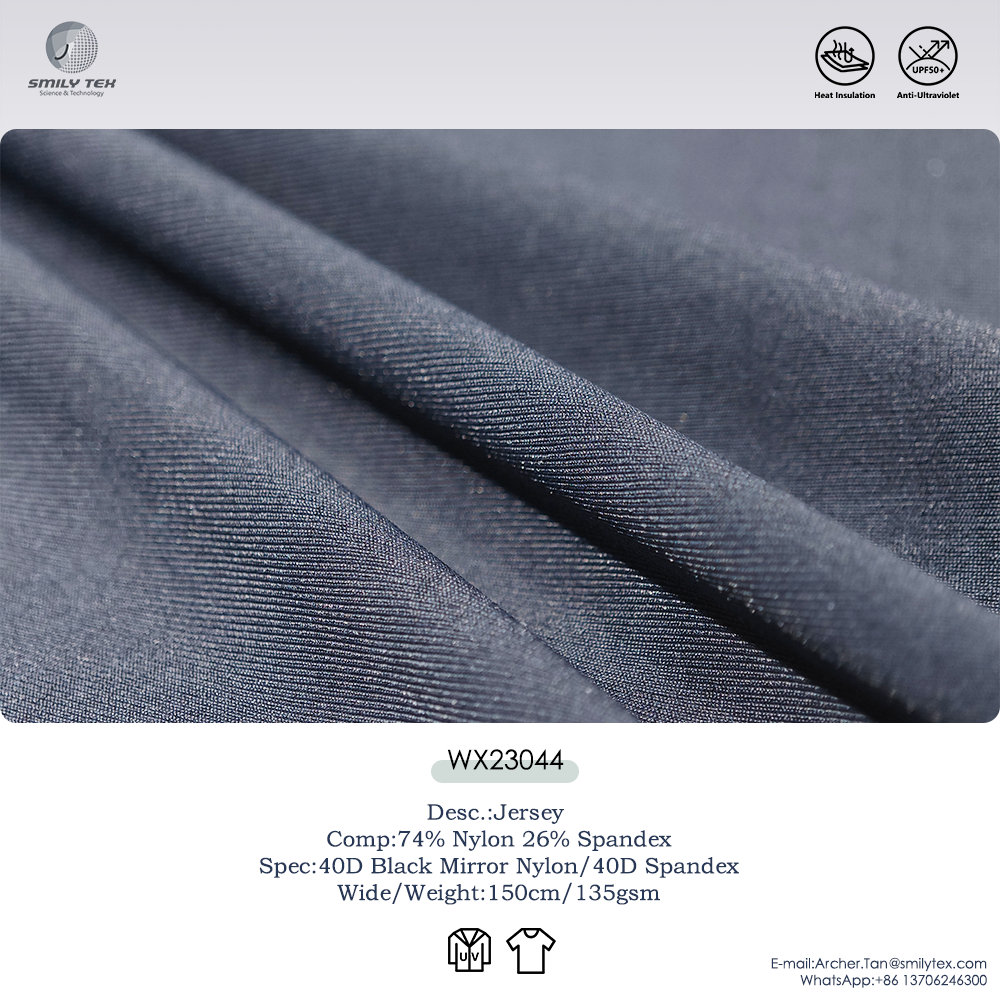
Black Mirror® WX23044-3 — the insulation route is usually specified for outdoor, sport and leisure programs.
Comparing Functional Polyester Filament Lines for US Projects
The table below summarizes the documented specifications of the Smilytex lines most relevant to a thermal US apparel brief. It is a specification comparison and not a ranking: the correct line is the one whose documented function matches the job the garment has to do.
| Product line | Yarn type | Documented functions | Denier range | Documented application areas |
|---|---|---|---|---|
| Black Mirror® | DTY multi-functional composite fiber (polyester + polyamide) | Heat insulation, anti-ultraviolet, see-through resistance | 30D, 50D, 75D, 100D, 150D, 300D | Sports, leisure, outdoor; woven and knitted |
| Swarin® | DTY recycled polyester (far-infrared heat) | Odor control, far infrared heating, anti-microbial | 30D, 50D, 75D, 100D, 150D, 300D | Apparel, leisurewear, underwear, sportswear, home textile |
| Cocarber® | DTY Cocarber (recycled coffee grounds + recycled PET bottle flakes) | Recycled coffee waste, odor control, far infrared heating, quick dry, dope dye, anti-microbial | 30D, 50D, 75D, 100D, 150D, 300D | Sport, leisure, underwear, home textile |
| Physcool® | DTY Physcool | Instant cooling, anti-UV, anti-microbial | 30D, 50D, 75D, 100D, 150D, 300D | Sport, business, leisure; woven and knitted |
| Respawn® | DTY recycled polyester (T2T, chemical recycling and polymer rebuilding) | Low temperature dye, moisture management | Filament and staple fiber | Sport, leisure, home textile; woven and knitted |
| Rimens® | DTY / ATY polyester (cotton-like) | Cotton-like feel, non spandex elasticity | 60D, 80D, 90D, 130D, 160D, 190D, 260D, 320D, 450D | Sport, leisure, home textile |
Two construction and verification anchors sit behind several rows of that table and are summarized separately, because they are the items a US buyer is most often asked to confirm during vendor qualification.
| Anchor | What it covers | Where it applies |
|---|---|---|
| GB/T 30127-2013 | Textiles — Testing and Evaluation of Far Infrared Performance; the testing method follows this standard | Far-infrared performance for the far-infrared routes described here |
| LC-MSMS, caffeine residue: 0.009 mg/kg | Caffeine residue testing | Cocarber® recycled coffee-ground projects |
| OEKO-TEX Standard 100 / Global Recycled Standard (GRS) | Certification programs requiring at least 20% recycled content for specific labeling | Recycled-content claims on recycled yarn routes |
| Sheath-core composite yarn shape; 15% functional additive powder | Documented construction requirement for the composite route | Black Mirror® composite filament |
Frequently Asked Questions
1. What test standard verifies far-infrared performance in these yarns?
Far-infrared performance for the application scenarios described here is tested under GB/T 30127-2013, Textiles — Testing and Evaluation of Far Infrared Performance, and the testing method follows that standard. This matters in practice because Chinese market requirements for this product family are already defined around that method, so a US buyer receives a test reference rather than a verbal claim. For the recycled coffee-ground route, Cocarber® projects also reference LC-MSMS testing with a caffeine residue result of 0.009 mg/kg. If the program carries a recycled-content claim, note that OEKO-TEX Standard 100 and the Global Recycled Standard require at least 20% recycled content for specific labeling, so the recycled share should be confirmed against the label the brand intends to use.
2. What does far-infrared heating functional polyester actually do in a finished garment?
Swarin® absorbs and reflects the infrared rays emitted by the human body so that the fiber itself generates heat, compensates for heat lost to the external environment and maintains relatively stable body temperature. Its documented function set is odor control, far infrared heating and anti-microbial performance, available in 30D, 50D, 75D, 100D, 150D and 300D deniers for apparel, leisurewear, underwear, sportswear and home textile use. Black Mirror® adds heat insulation, anti-ultraviolet and see-through resistance through a sheath-core composite yarn shape that combines polyester fiber and polyamide fiber and carries an extra large functional additive powder content of 15%, in 30D to 300D for sports, leisure and outdoor applications in both woven and knitted constructions. Used together, they cover warmth generation and heat retention in a garment that still feels light.
3. What drives the cost of a far-infrared heating yarn program?
The documented cost drivers in this category are the functional additive loading, the composite spinning route, the raw-material route, the dyeing route and the denier. Black Mirror® carries an extra large functional additive powder content of 15% inside a sheath-core composite structure, a construction that is more complex than a plain single-component filament. Dope-dyeing routes such as Cocarber® reduce the need for conventional dyeing, which helps save energy and resources and can remove a process step from the chain. Recycled feedstocks — recycled coffee grounds, recycled PET bottle flakes and T2T recycled polyester rebuilt through chemical recycling and polymer rebuilding — each bring their own sourcing considerations. Pricing is quoted per program rather than published, so the practical approach is to fix function, denier and construction first and then request a quotation on that defined brief.
4. How should a US brand validate a far-infrared heating yarn before bulk production?
Validation should mirror production. The documented chain runs from spinning into yarns, to weaving or knitting into fabrics, to finishing and processing into functional garments, and testing is carried out with functional testing instruments alongside spinning machines, weaving or knitting looms and fabric finishing equipment. A workable sample plan therefore tests the finished construction for far-infrared performance, heat insulation, anti-ultraviolet protection and opacity rather than relying on yarn-stage data alone. Denier, knit or woven structure and the dyeing route should all be fixed before the sample is built, so that the result is representative of what bulk production will deliver.
5. What affects lead time on a far-infrared heating program, and how do we start?
Lead time in this category is shaped by three decisions taken early in the chain: the yarn function route (single function versus composite), the dyeing route (dope dyeing removes a conventional dyeing step), and whether sample validation is completed before bulk. Smilytex documents an annual production capacity of approximately 20 tons from a 16,220 m² facility, supported by an R&D team of 10 engineers and professionals and approximately 206 staff, with export business accounting for approximately 70% of total sales across the EU, USA and JP. The simplest way to start is to send the garment brief — function, denier, construction and target market — and request a sample or a quotation. Email Archer.Tan@smilytex.com, call 86-512-53991066, message WhatsApp at +86-13706246300, or visit www.smilytex.com. The full product brochure can be downloaded here: Smilytex functional filament brochure (PDF).
Conclusion: A Practical Next Step
Far-infrared heating functional polyester earns its place in a US apparel program for a narrow and testable reason: it generates warmth from the wearer’s own infrared emission, so a thin garment can carry thermal performance that used to require bulk. The route only works end to end, however, when it is specified alongside the properties that decide wearability — heat insulation, anti-ultraviolet protection and see-through resistance — and when the specification states the construction behind the claim, such as a sheath-core composite yarn shape with a 15% functional additive powder content.
Three decisions carry most of the risk. First, whether the garment needs warmth generation, heat retention, or both. Second, whether the feedstock story is conventional, recycled, or recycled coffee-ground based, because each route changes the documentation a brand must hold. Third, whether the sample was built on the same chain as bulk production, so that the test result transfers to the finished garment.
Smilytex develops and sells functional fiber and functional fashion fabrics, including far infrared heating and far infrared thermal retention polyester filament, coffee charcoal antibacterial polyester filament, anti see through hydrophilic polyester filament, UV resistant heat shielding polyester filament and a wider portfolio of recycled, cooling, moisture management and cotton touch variants. If you are scoping a US thermal program for an upcoming season, the next step is a sample built on your own garment brief.
Request a sample or quotation. Send your function, denier, construction and target market, and the Smilytex team will respond with the matching yarn route and the documentation package for that route.
Email: Archer.Tan@smilytex.com | Tel: 86-512-53991066 | WhatsApp: +86-13706246300 | Website: www.smilytex.com
Brochure: Download the Smilytex functional filament brochure (PDF)
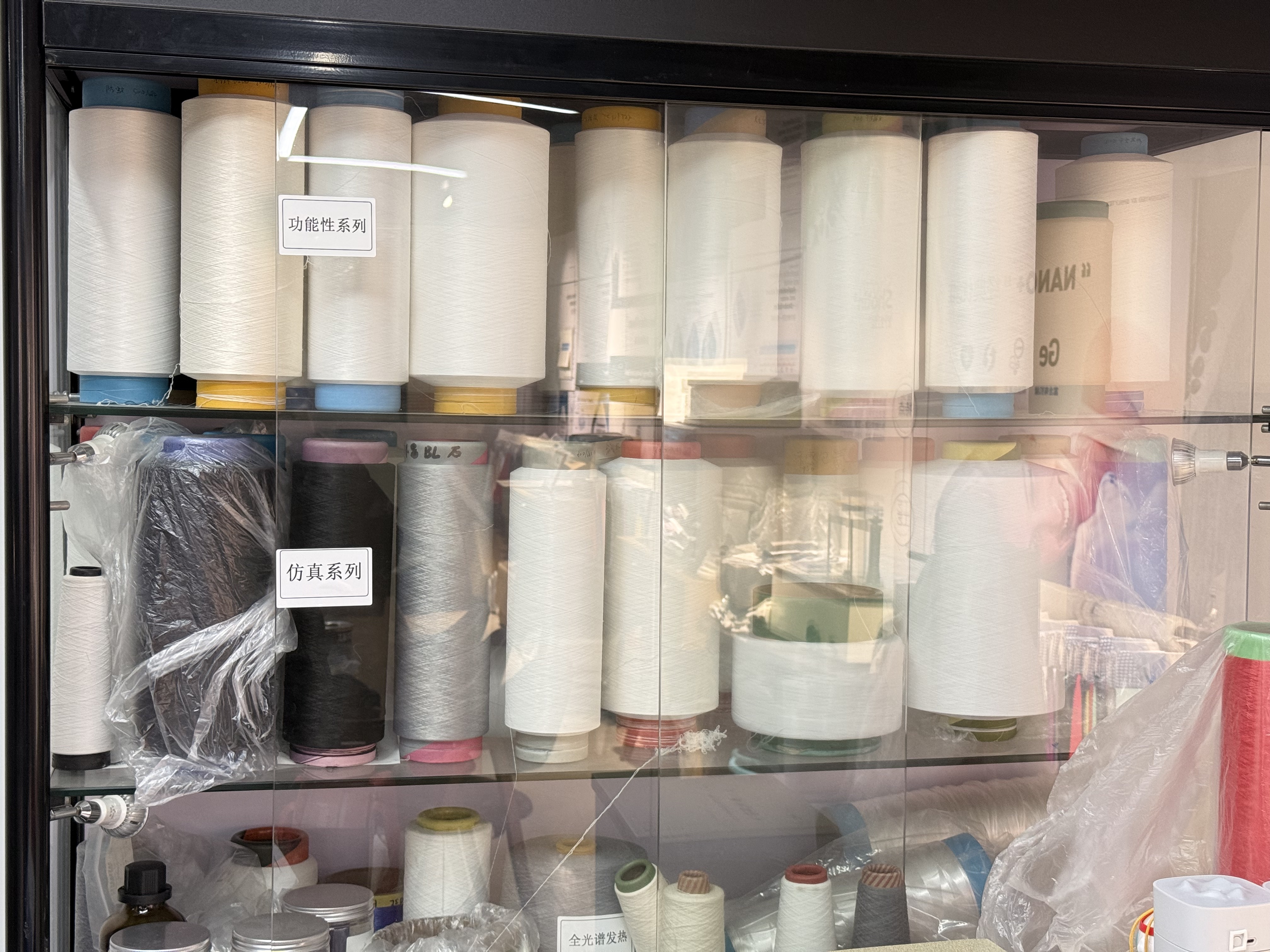
About Smilytex
Smily Textile Technology (Taicang) Co., Ltd. is a functional textile materials company established in 2017, specializing in the research and development and sales of functional fiber and functional fashion fabrics. The company operates a 16,220 m² facility with approximately 206 staff and an R&D team of 10 engineers and professionals, holds more than 20 core patented technologies, and serves major markets in the EU, USA and JP, with export business accounting for approximately 70% of total sales.
Address: No.6 Weast Beijing Road, Taicang City, Jiangsu Province, China
Website: www.smilytex.com | Blog: blog.smilytex.com | Email: Archer.Tan@smilytex.com
Have Questions or Need More Details?
Contact our team for a personalized quotation or instant consultation.
Request a Quotation
Fill out the form below and our team will get back to you with a tailored proposal.
WhatsApp Direct Chat
Prefer to chat in real-time? Message us on WhatsApp for instant assistance & quick answers.
- Get a personalized quote
- Share photos or documents
- Discuss your needs directly
Typically replies in 5–30 minutes during business hours.