GRS/RCS Certified Functional Polyester Filament: What Buyers Must Verify Before Ordering
For procurement and R&D teams evaluating functional polyester filament with recycled-content requirements.
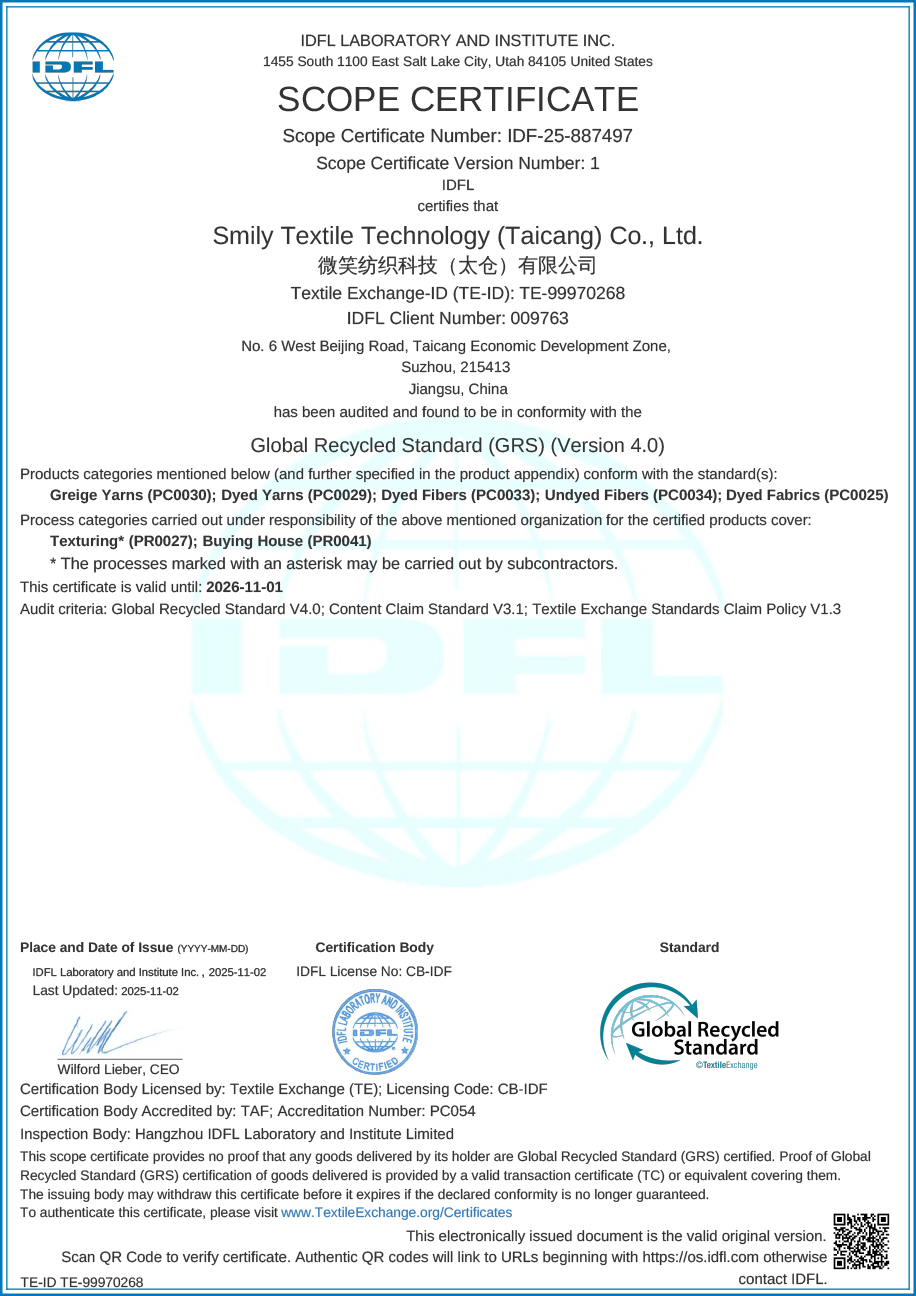
Image: Global Recycled Standard (GRS) scope certificate held by Smily Textile Technology (Taicang) Co., Ltd.
If your brand requires functional polyester filament with a verified sustainability claim, the certification evidence you inspect before ordering matters more than the marketing language on a supplier’s homepage. Global Recycled Standard (GRS) and Recycled Claim Standard (RCS) certifications provide the documentation trail needed for EU and US brand supply chains. This guide explains what GRS/RCS certification covers, how to verify a filament supplier’s scope certificate, and which product and market details buyers should check before approval.
Why GRS/RCS Certification Is a Procurement Requirement, Not a Marketing Tag
Global retailers and apparel brands increasingly request recycled polyester filament with third-party certification. GRS and RCS are voluntary, chain-of-custody standards that track recycled content from the input material through yarn and fabric production. A scope certificate does not claim that every product in the supplier’s catalog is recycled; it defines which product categories are covered and under which standard.
For a functional filament buyer, the key implication is this: a supplier may hold a valid GRS or RCS scope certificate, but that certificate only applies to the product types, sites, and standards listed on it. Confirming the certificate number, issuing body, expiry date, and covered scope is part of responsible sourcing — not optional due diligence.
The majority of recycled-content standards, including GRS and OEKO-TEX guidelines, require a minimum percentage of recycled content for specific labeling. In practice, buyers should confirm the exact recycled-content ratio with the supplier and cross-check it against the certificate scope.
GRS vs. RCS: Which Certification Applies to Your Filament Order?
GRS and RCS are both administered within the same recycled-content certification framework, but they answer different procurement needs.
| Comparison Point | GRS (Global Recycled Standard) | RCS (Recycled Claim Standard) |
|---|---|---|
| Primary focus | Recycled content plus social, environmental, and chemical requirements | Verification of recycled content in the final product |
| Typical market relevance | EU, US, and global brand supply chains requiring deeper sustainability assurance | EU, US, and global brand supply chains where the claim is mainly recycled content |
| Documentation you receive | Scope certificate and transaction certificate | Scope certificate and transaction certificate |
| Typical buyer use | Brands with public sustainability targets or multi-criteria sourcing policies | Brands that need a downstream recycled-content claim for specific products |
Both certifications are visible to downstream buyers through the certifier’s verification process. A supplier’s scope certificate should be shared with you during qualification. You should also request transaction certificates against your purchase orders to link the certified input to your specific shipment.
What a Valid GRS/RCS Scope Certificate Must Show
Not all certificates are equal in procurement value. Before you accept a supplier’s sustainability claim, verify the following fields on the scope certificate:
- Certification standard: For example, GRS V4.0 or RCS 2.0. Confirm the version because standard requirements can change over time.
- Certificate number: Always record the number. It allows you to check validity with the certification body.
- Issuing body: The certifier should be a recognized, independent organization, such as IDFL Laboratory and Institute Inc.
- Covered products: Check whether the scope includes the product type you are sourcing — dyed yarns, greige yarns, dyed fibers, undyed fibers, dyed fabrics, or a combination.
- Applicable markets: Confirm the certificate covers the destination region for your supply chain, such as EU, US, or global brand supply chains.
- Issue and expiry dates: An expired or expiring certificate should be updated before you commit to a large order.
This checklist applies regardless of whether the filament is a conventional recycled polyester or a specialized functional variant.
Case Example: GRS/RCS Certifications in a Functional Filament Supply
Smily Textile Technology (Taicang) Co., Ltd., operating as Smilytex, provides an example of how certification documentation works in a functional filament catalog. Smilytex was established in 2017 and operates from a 16,220 m² facility in Taicang, Jiangsu Province, China. The company holds two relevant scope certifications, both issued by IDFL Laboratory and Institute Inc.:
- RCS 2.0 — certificate number IDF-25-887506, issued 2025-11-02, valid until 2026-11-01. The scope covers dyed yarns, greige yarns, dyed fibers, undyed fibers, and dyed fabrics for the EU, US, and Global Brand Supply Chains markets.
- GRS V4.0 — certificate number IDF-25-887497, issued 2025-11-02, valid until 2026-11-01. The scope covers greige yarns, dyed yarns, dyed fibers, undyed fibers, and dyed fabrics for the EU, US, Global Brand Supply Chains, and China markets.
These certificates apply to Smilytex’s functional polyester product families, including Cocarber®, Black Mirror®, Rimens®, Respawn®, and Swarin®. In customer cases, the use of GRS/RCS-certified recycled materials has been highlighted as the basis for meeting a brand’s sustainable development requirements.
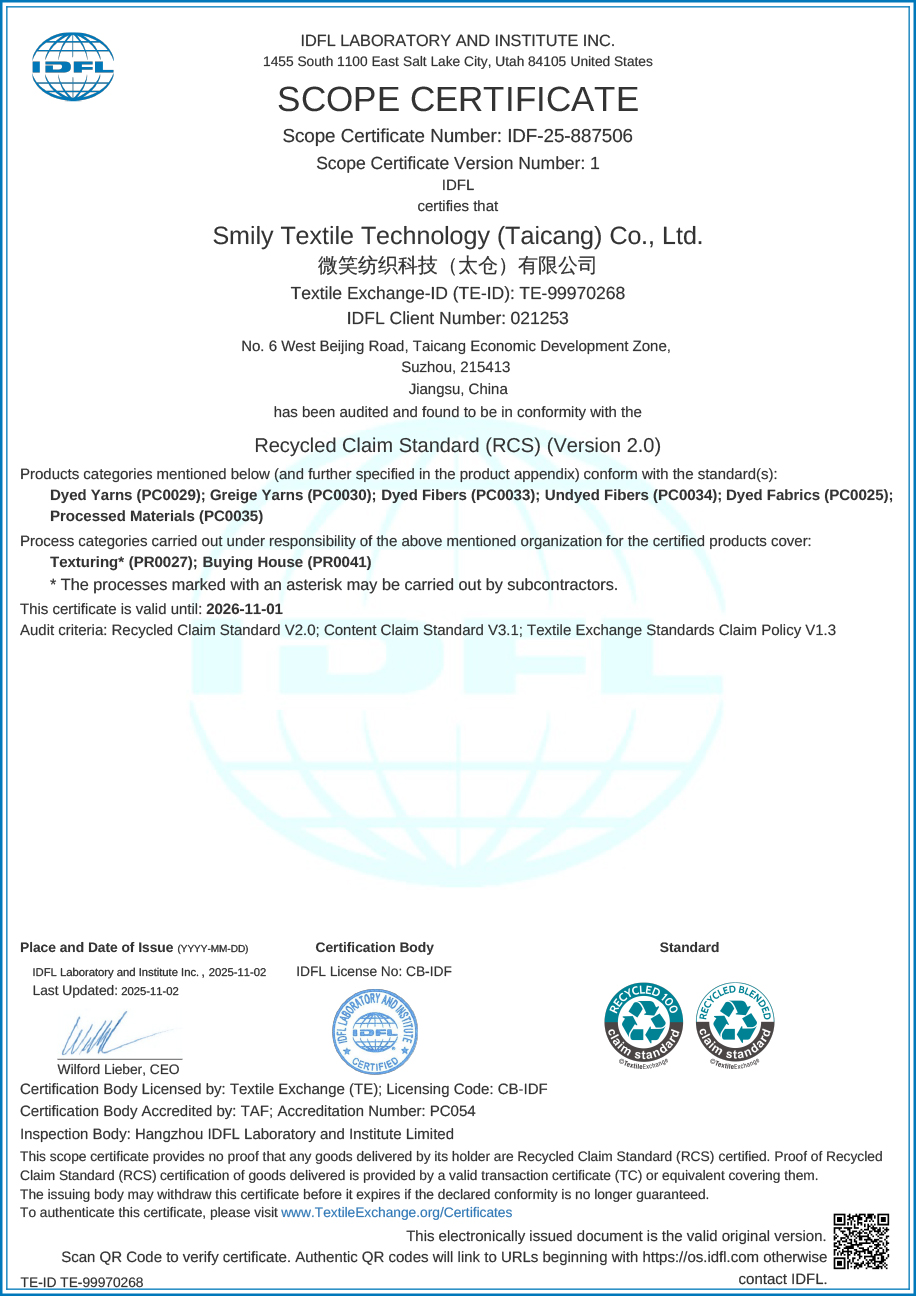
Image: Example of a scope certificate issued by IDFL Laboratory and Institute Inc. for recycled-content yarns and fabrics.
Which Functional Polyester Filament Products Typically Carry Recycled-Content Certification?
Recycled-content certification is most relevant when the product itself is positioned as a sustainable filament. In Smilytex’s case, the certified product families include:
| Product | Key Function | Typical Applications |
|---|---|---|
| Cocarber® | Recycled coffee waste, odor control, far infrared heating, quick dry, dope dye, anti-microbial | Sport, leisure, underwear, home textile |
| Black Mirror® | Heat insulation, anti-ultraviolet, see-through resistant | Sports, leisure, outdoor, woven and knitted |
| Rimens® | Cotton-like touch, non-spandex elasticity | Sport, leisure, home textile |
| Respawn® | T2T recycled polyester, low temperature dyeing, moisture management | Sport, leisure, home textile, woven and knitted |
| Swarin® | Odor control, far infrared heating, anti-microbial | Apparel, leisure, underwear, sport, home textile |
For buyers, this means that recycled-content certification can coexist with advanced functional properties. The documented scope matters more than the product name.
Step-by-Step: Verifying a Functional Polyester Filament Supplier’s GRS/RCS Certificate
Follow this workflow during supplier evaluation to avoid accepting an invalid or incomplete certification claim.
- Request the scope certificate directly. Ask the supplier to share the full PDF, not just a screenshot of the front page.
- Read the standard name and version. Confirm whether it is GRS V4.0, RCS 2.0, or another version.
- Record the certificate number. The number should be unique, such as IDF-25-887506 or IDF-25-887497.
- Check the issuing body. Recognize the certifier and verify its legitimacy through the certification body’s own records where possible.
- Review the covered product scope. Match the product category against the certificate — dyed yarns, greige yarns, dyed fibers, undyed fibers, dyed fabrics.
- Check market applicability. Confirm the certificate covers your destination market or brand supply chain, for example EU, US, or global brand supply chains.
- Check validity dates. Ensure the certificate has not expired or is not about to expire before your expected shipment window.
- Request transaction certificates. For each order, ask for the transaction certificate that links the certified material to your purchase.
- Audit product-level claims. Confirm the recycled-content percentage for the specific filament you plan to order, because a scope certificate alone does not define the recycled ratio of every product.
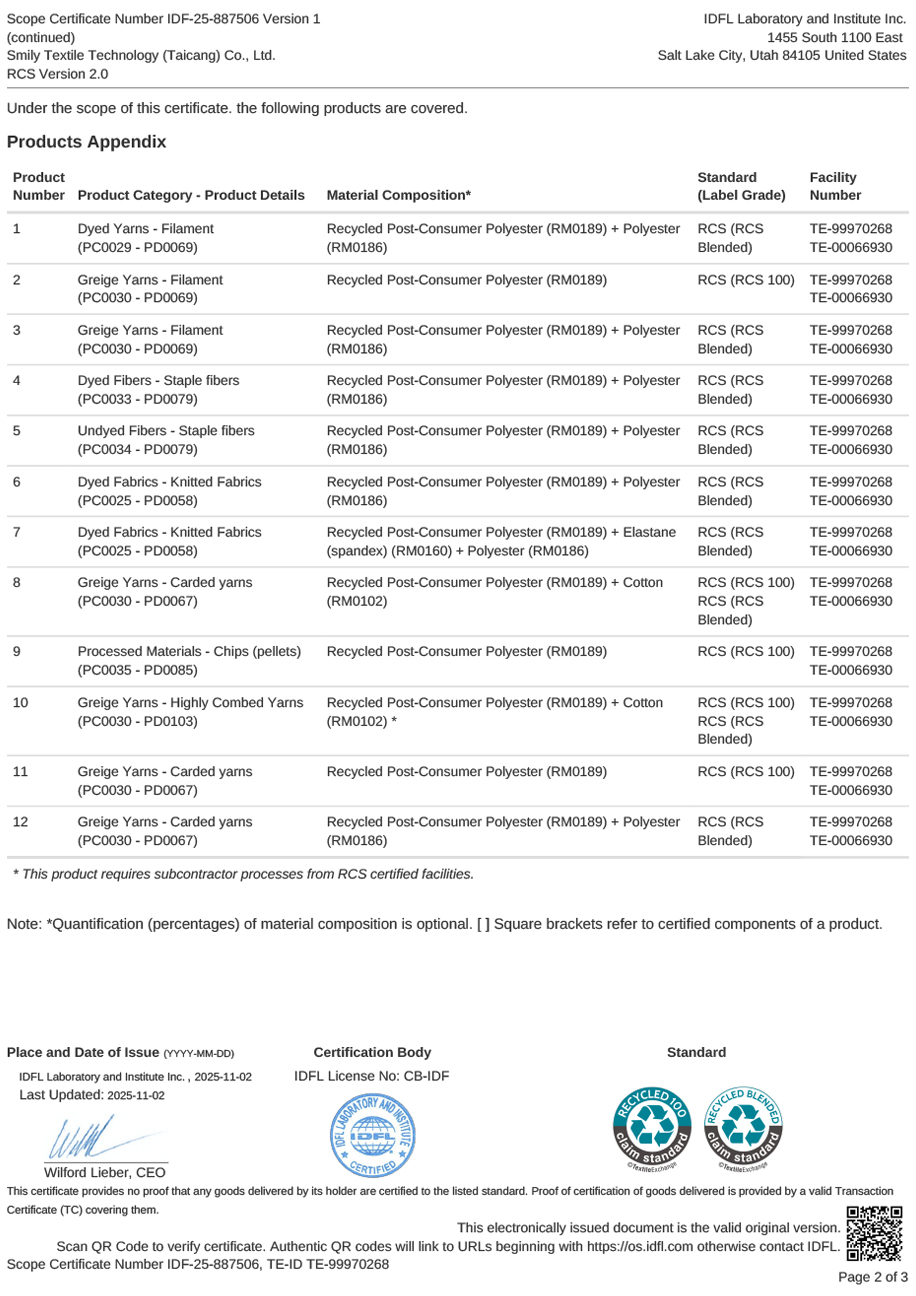
Image: Certificate detail fields buyers should verify, including standard version, certificate number, scope, and validity dates.
Common Pitfalls When Reviewing Recycled-Content Certificates
Procurement teams often encounter the same set of issues when reviewing certifications:
- Relying on a home page logo. A logo without a certificate number and scope does not prove coverage of your product.
- Ignoring the scope. A certificate may cover only undyed fibers while you are purchasing dyed yarns.
- Ignoring market validity. Some certificates are limited to specific geographies; a certificate may not be valid for the market into which you are importing.
- Assuming all products are certified. The certificate defines the covered product categories, not the entire supplier catalog.
- Neglecting expiry dates. Certificates are typically valid for a fixed period. An expiring certificate can interrupt chain-of-custody claims if not renewed.
Market Context: Why This Matters in 2026
The commercial relevance of certified recycled polyester filament continues to grow. The global polyester fiber market is projected to expand from USD 82.07 billion in 2025 to USD 148.11 billion by 2034. The global recycled polyester market is expected to grow from USD 15.52 billion in 2024 to USD 26.18 billion by 2030 at a 9.25% CAGR (Grand View Research). In this environment, brands are moving from general sustainability statements to documented, verifiable claims.
Athleisure and performance apparel brands favor moisture-wicking and antimicrobial polyester blends, and they increasingly combine those performance requirements with recycled-content goals. Functional polyester filament with documented GRS or RCS certification allows brands to meet both performance and sustainability targets in a single material platform.
Questions to Ask Your Supplier Before Placing an Order
Use these questions as a short qualification checklist:
- Which recycled-content standards does your facility hold, and what are the certificate numbers?
- Which certifier issued the certificate, and when does it expire?
- Does the certificate scope include the specific product I am sourcing — for example, dyed yarns and dyed fabrics?
- Is the certificate valid for my target market, such as the EU or US brand supply chain?
- What is the recycled-content percentage of the specific filament model I want to order?
- Can you provide a transaction certificate against my purchase order?
FAQ
What is GRS V4.0, and what does it cover for functional polyester filament?
GRS (Global Recycled Standard) V4.0 is a third-party certification standard for recycled materials and their chain of custody. For functional polyester filament, GRS V4.0 certification applies to products including greige yarns, dyed yarns, dyed fibers, undyed fibers, and dyed fabrics. It is relevant for suppliers serving EU, US, and global brand supply chains. At Smilytex, the GRS V4.0 certification is held under certificate number IDF-25-887497, issued by IDFL Laboratory and Institute Inc.
What is RCS 2.0, and how does it differ from GRS for filament buyers?
RCS (Recycled Claim Standard) 2.0 is a recycled-content verification standard that tracks recycled material through the supply chain. It differs from GRS in its broader emphasis: GRS includes social, environmental, and chemical requirements in addition to recycled content, while RCS is more focused on the recycled-content claim itself. For Smilytex’s functional polyester filament, the RCS 2.0 certificate number is IDF-25-887506, valid through 2026-11-01.
Which products are covered by Smilytex’s GRS/RCS scope certificates?
The GRS V4.0 certificate covers greige yarns, dyed yarns, dyed fibers, undyed fibers, and dyed fabrics for the EU, US, Global Brand Supply Chains, and China markets. The RCS 2.0 certificate covers dyed yarns, greige yarns, dyed fibers, undyed fibers, and dyed fabrics for the EU, US, and Global Brand Supply Chains markets. These scopes apply to the Cocarber®, Black Mirror®, Rimens®, Respawn®, and Swarin® product families.
Can I request a sample to verify certified functional polyester filament?
Yes. Buyers evaluating certified functional polyester filament should request a sample and a copy of the scope certificate during qualification. For Smilytex, sample and inquiry requests can be directed to Archer.Tan@smilytex.com, by phone at +86-512-53991066, or via WhatsApp at +86-13706246300. The company brochure is available at https://cdn.socialarks.com/sbsp//common/2026/0320/69bcda7273f49.pdf for reference.
Conclusion
GRS/RCS certification gives functional polyester filament buyers a verifiable basis for recycled-content claims. Before ordering, confirm the standard version, certificate number, issuing body, covered product scope, market applicability, and validity dates. A documented certification chain — supported by transaction certificates — protects your brand’s sustainability claims and simplifies downstream compliance.
Need certified functional polyester filament for your next sportswear or performance apparel program?
Contact Smilytex for samples, specifications, and certificate documentation.
Email: Archer.Tan@smilytex.com
Tel: +86-512-53991066
WhatsApp: +86-13706246300
Have Questions or Need More Details?
Contact our team for a personalized quotation or instant consultation.
Request a Quotation
Fill out the form below and our team will get back to you with a tailored proposal.
WhatsApp Direct Chat
Prefer to chat in real-time? Message us on WhatsApp for instant assistance & quick answers.
- Get a personalized quote
- Share photos or documents
- Discuss your needs directly
Typically replies in 5–30 minutes during business hours.