A Technical Deep Dive into Functional Polyester Filament: Interpreting Key Parameters and Understanding Production Processes (2026)
Functional polyester filament has become a cornerstone material for high-performance apparel, offering engineered properties that go beyond the capabilities of standard polyester. For industrial engineers and procurement professionals, understanding the technical parameters and production processes is essential to selecting the right material for specific end-uses. This article provides a detailed analysis based on proven industry solutions, using the product lines from Smily Textile Technology (Taicang) Co., Ltd (brand Smilytex) as a reference point.
1. Core Technical Parameters: What the Numbers Mean
The performance of a functional polyester filament is defined by a set of measurable parameters. Below are key parameters illustrated through Smilytex's product families.
Denier (D) and Filament Count
Denier indicates the linear mass density of the filament. For example, the Rimens® series is offered in denier sizes including 60D, 80D, 90D, 130D, 160D, 190D, 260D, 320D, and 450D (source: product specification). Lower denier yields finer yarns suitable for lightweight fabrics, while higher denier provides durability and structure. The choice directly affects fabric hand feel, coverage, and draping behavior.
Functional Additives and Performance Metrics
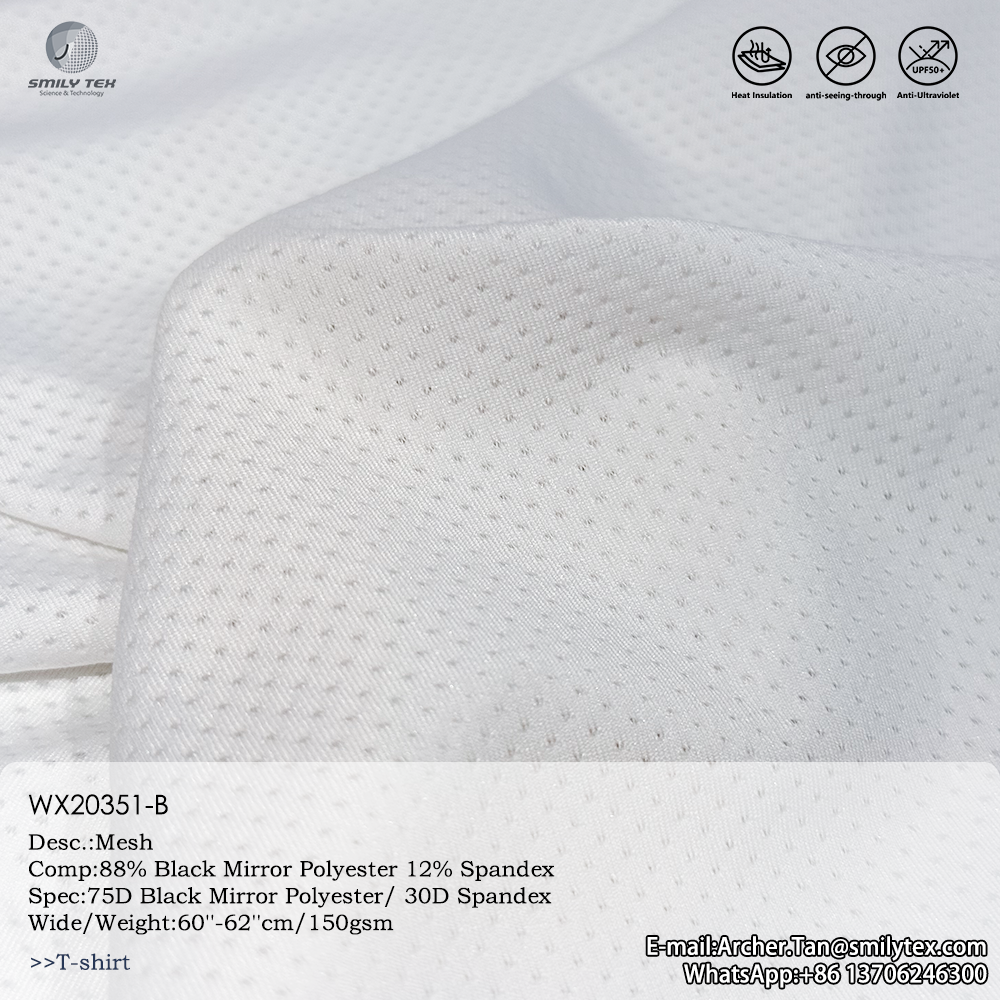
Functional filaments rely on masterbatch additives or specialized fiber shapes. For instance, the Black Mirror® series is a multi-functional composite fiber designed for sports, leisure, and outdoor applications (source: citable text). Its functional capabilities include heat insulation, anti-ultraviolet protection, and see-through resistance (source: citable text). The material is a sheath-core composite yarn containing an extra large amount of functional additive powder (15%) (source: application scenario). This design enables UPF values of 40–60+ depending on fabric construction and color, as tested per standard.
Similarly, the Rimens® series delivers a cotton-like feel and non-spandex elasticity (source: citable text). It is a DTY/ATY polyester filament that uses special nano powders to create multiple cross-sections mimicking natural cotton (source: application scenario). The material is Cotton Like Polyester, and its elasticity is achieved without spandex, providing improved durability and ease of care.
Specialized Functions
- UV Protection: Black Mirror® achieves UPF 40–60+ (tested per standard), offering reliable sun protection for outdoor and workwear.
- Antibacterial & Odor Control: Cocarber® series, which uses recycled coffee waste, provides antibacterial rates ≥90% (ISO/AATCC methods) and far infrared heating validated per GB/T 30127-2013 (source: application scenario).
- Moisture Management: Physcool® series and Respawn® series offer instant cooling and moisture-wicking; drying time is reduced by 30–50% compared to regular polyester (source: comparison unit).
2. Production Processes and Their Impact on Quality
The way a functional filament is manufactured determines whether its promised performance remains consistent during fabric production and garment use.
Dope-Dye vs. Piece-Dye
Dope-dyed filaments (e.g., Cocarber® and some Black Mirror® variants) incorporate pigments at the polymer stage before spinning. This eliminates the need for conventional dyeing, significantly reducing water and energy consumption. The resulting color is more resistant to fading over 30–50 washes. In contrast, piece-dyed filaments allow greater flexibility in color matching but require careful batch control to avoid shade variation (source: risk unit).
Masterbatch Addition and Fiber Structure
For high-performance functions, such as UV shielding or far infrared emission, additive powder must be uniformly dispersed. Black Mirror® uses a sheath-core configuration with 15% functional additive, ensuring the active material stays at the fiber surface for maximum efficacy (source: application scenario). This design also improves abrasion resistance and maintains performance after laundering. In comparison, Rimens® achieves its cotton-like texture through special nano powders that modify the fiber cross-section, resulting in a softer luster and enhanced moisture management.
Spinning and Draw Texturing
All Smilytex functional filaments are produced via advanced draw texturing (DTY) or air texturing (ATY) to impart bulk, stretch recovery, and a specific hand feel. The process parameters (temperature, draw ratio, air pressure) are precisely controlled to ensure consistent tensile strength and elongation. For example, Rimens® ATY versions offer higher volume and a more cotton-like draping length, while DTY versions provide sharper performance for activewear.
Quality Control and Traceability
Smilytex implements 100% testing for key parameters (GSM, width, shrinkage, color) and maintains batch traceability records. Each production lot is retained for verification, and a CAPA (Corrective and Preventive Action) system addresses any deviations (source: risk unit). The company holds Global Recycled Standard (GRS) and Recycled Claim Standard (RCS) certifications (certificates IDF-25-887497 and IDF-25-887506, issued by IDFL Laboratory), valid through November 2026, covering recycled polyester yarns and fabrics.
3. Common Misconceptions in Technical Selection
Procurement professionals often fall into three traps when evaluating functional polyester filament:
Misconception 1: Relying Only on Nominal Parameters
Many buyers assume a UPF 50+ filament will provide the same protection in any fabric. In reality, UPF performance depends heavily on fabric construction (cover factor, yarn spacing, color) and garment design. A filament with 15% UV additive may still yield only UPF 20 in a very open knitted structure. Always require fabric-level test data from a third-party lab (e.g., according to AATCC 183 or AS/NZS 4399) using the intended fabric construction.
Misconception 2: Ignoring Performance Durability
Initial antibacterial rates of 99% are meaningless if the function washes out after 10 cycles. Look for wash durability specifications. Smilytex’s functional filaments are designed to maintain performance for 30–50 laundry cycles as verified by internal and external tests (source: comparison unit). Always request wash durability data aligned with your target end-use.
Misconception 3: Confusing “Cotton-Like” with True Cotton
Non-spandex elastic filaments like Rimens® provide stretch recovery (up to 20–30% elastic elongation) without the use of rubber or spandex, but they do not absorb moisture like natural cotton. Their advantage is quick-drying and shape retention. Buyers seeking moisture absorption should specify a hydrophilic variant or blending strategy. Rimens® can be customized with hydrophilic additives when needed (source: product customization).
4. Chinese Supplier Advantages: Engineering Expertise and Sustainability
China’s functional polyester filament manufacturers, typified by Smilytex, have established technological capabilities that match or exceed international benchmarks.
- R&D and Patents: Smilytex owns more than 20 core patented technologies, including authorized invention patents and utility model patents (source: company profile). Its R&D team of 10 engineers focuses on novel additive formulations and fiber structures.
- Customization and MOQ: The company can tailor yarn styles, elasticity, hand feel, and functional attributes (UV, antibacterial, moisture management, far infrared) according to customer requirements. Minimum order quantity is 500 kg for yarns and 500 kg for fabrics (source: capability unit).
- Sustainability Credentials: In addition to GRS/RCS certifications, Smilytex offers T2T (Textile-to-Textile) recycled polyester (Respawn®) and low-temperature dyeable variants that reduce energy consumption during processing. The use of recycled coffee waste in Cocarber® exemplifies circular economy practices.
- Global Market Reach: 70% of production is exported to EU, USA, and Japan, with a demonstrated track record of supplying branded apparel manufacturers and OEMs (source: company profile).
By combining cost-effective manufacturing with rigorous quality control and third-party certifications, Chinese suppliers like Smilytex offer a reliable sourcing option for demanding technical applications.
Conclusion and Further Resources
Selecting the right functional polyester filament requires a thorough understanding of both technical parameters and production processes. By moving beyond simple label claims and considering real-world performance, fabric construction compatibility, and wash durability, procurement professionals can avoid costly mistakes. For detailed product specifications and test reports, the company brochure is available for download:
Have Questions or Need More Details?
Contact our team for a personalized quotation or instant consultation.
Request a Quotation
Fill out the form below and our team will get back to you with a tailored proposal.
WhatsApp Direct Chat
Prefer to chat in real-time? Message us on WhatsApp for instant assistance & quick answers.
- Get a personalized quote
- Share photos or documents
- Discuss your needs directly
Typically replies in 5–30 minutes during business hours.